Enterprise SEO is not simply standard SEO applied at a larger scale. For organisations managing hundreds or thousands of web pages, multiple domains, large content teams, and competitive commercial intent keywords, the operational demands, strategic complexity, and technical depth required are significantly different. Getting this right in 2026 is a serious business priority.
What Sets Enterprise SEO Apart from Standard SEO
Most SEO fundamentals apply across the board — technical health, authoritative content, relevant backlinks, and a sound site architecture. But the moment a business moves into enterprise territory, the challenge shifts from execution to orchestration.
An enterprise website might contain tens of thousands of indexed pages. Even minor inefficiencies — duplicate content patterns, crawl budget mismanagement, inconsistent internal linking, or poorly structured URL hierarchies — can suppress organic performance across entire site sections rather than individual pages.
At this level, SEO decisions intersect with infrastructure. Page speed depends on CDN configuration and server response times. Structured data implementation requires coordination with development teams. Content publication at scale demands clear workflow governance, editorial processes, and taxonomy management.
Enterprise SEO is also organisationally complex. It involves aligning marketing, product, IT, compliance, and content functions around a shared organic growth strategy. Without that alignment, execution stalls, priorities conflict, and campaigns underperform.
The Core Pillars of Enterprise SEO in 2026
Technical SEO at Scale
Technical SEO forms the foundation of any enterprise programme. At scale, the priorities include:
- Crawlability and indexation control — Ensuring that search engine bots are crawling high-value pages efficiently, and that low-value pages are appropriately managed through directives, canonical tags, or parameter handling.
- Core Web Vitals and performance — Google’s performance signals continue to affect ranking potential. For enterprise sites, improving Largest Contentful Paint, Cumulative Layout Shift, and Interaction to Next Paint often requires close collaboration between SEO and engineering teams.
- Log file analysis — Understanding exactly how Googlebot interacts with the site, identifying crawl waste and prioritisation issues, is a technique standard SEO campaigns rarely invest in but one that can reveal significant inefficiencies at enterprise scale.
- Schema markup and structured data — Implementing product, article, FAQ, organisation, and event markup across large content sets requires automation and systematic QA, not manual page-by-page additions.
Enterprise Content Strategy
Content at enterprise scale is not just about volume. The risk of producing large amounts of content without strategic cohesion is keyword cannibalisation, thin page proliferation, and authority dilution across the site.
A well-structured enterprise content strategy defines clear topic clusters, content hierarchies, and internal linking architecture. It identifies where existing content can be consolidated, improved, or retired rather than simply adding more pages.
In 2026, the expectation from search engines and from AI answer systems is topical depth, factual accuracy, and demonstrable subject authority. Businesses that produce high volumes of generic content will find diminishing returns. Those that build a structured, expert-led content framework perform sustainably.
Authority and Link Acquisition
Enterprise organisations often have a domain authority advantage over smaller competitors, but this does not eliminate the need for a consistent, quality-led link acquisition programme. Authority at the subdomain and page level still directly affects how individual pages compete for high-value commercial terms.
At enterprise scale, link building must be strategic. Reactive PR, digital outreach, thought leadership content, data-led publications, and targeted media relationships all contribute to a sustainable backlink profile. Low-quality, mass-volume link schemes carry disproportionate risk for enterprise organisations, where a manual action or algorithm penalty has much wider commercial impact.
Multi-Site and International SEO Complexity
Many enterprise organisations operate across multiple domains, subdomains, or country-targeted site variants. This introduces a specific set of technical and strategic challenges.
Hreflang implementation errors across large international sites are common and can result in the wrong page appearing for the wrong audience. Duplicate content across regional variants requires careful canonical and content differentiation strategies. International keyword research must account for genuine local search behaviour, not just direct translation of terms.
Managing multi-site SEO also requires clear ownership and a governance model. Without defined processes for who controls on-page decisions, technical changes, and content approvals across different site properties, coordination breaks down.
Choosing the Right Enterprise SEO Partner
Large organisations evaluating an enterprise SEO provider need to look beyond case study headlines and look at operational capability. The right questions to ask include:
- Can they work within your technical environment? Enterprise sites run on complex CMS platforms, custom-built stacks, and enterprise-grade infrastructure. An SEO provider that cannot translate recommendations into formats that developers can implement, or who lacks experience with platforms like Adobe Experience Manager, Salesforce Commerce Cloud, or headless architectures, will struggle to deliver value.
- Do they have a structured reporting framework? At enterprise level, SEO performance must be connected to commercial metrics — organic revenue contribution, pipeline influence, cost per acquisition compared to paid channels. Providers who report only on rankings or traffic without tying results to business outcomes are not operating at the level the organisation needs.
- How do they handle cross-functional coordination? The best enterprise SEO work happens when the agency acts as a genuine extension of the internal team — attending sprint planning, working directly with developers, briefing content teams, and feeding into product decisions. Providers who operate in isolation rarely move the needle on complex sites.
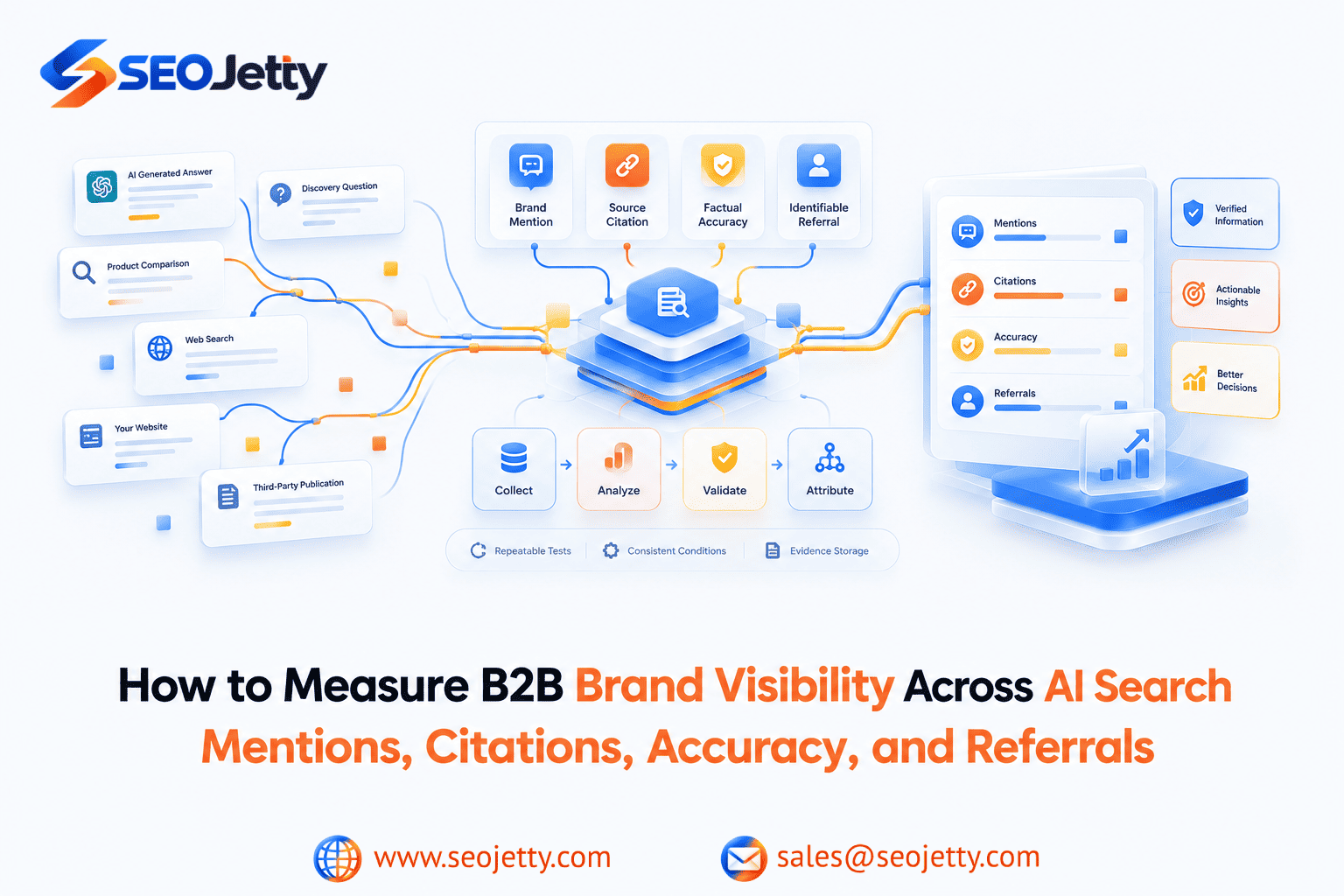
- What is their approach to AI search visibility? In 2026, the search landscape extends well beyond Google’s ten blue links. AI answer engines — including ChatGPT Search, Gemini, Perplexity, Copilot, and others — are increasingly cited as discovery channels, particularly for research-stage commercial queries. Enterprise SEO now encompasses optimisation for these systems, which requires a specific approach to content structure, entity coverage, and answer-ready formatting.
How SEO Jetty Supports Enterprise SEO Requirements
SEO Jetty is a digital marketing agency delivering AI-powered SEO and content optimisation services to businesses seeking scalable organic growth. Its enterprise SEO capability is built around the integration of AI-driven workflows and specialist SEO execution — a combination that addresses both the volume demands and the strategic complexity that large-scale organisations face.
The agency’s AI-Powered Search Engine Optimization service is designed to support enterprise-level requirements including technical auditing, site migration management, content optimisation at scale, keyword research, and link building. SEO Jetty also offers complementary services directly relevant to enterprise operations, including featured snippet optimisation, international AI SEO, dynamic content optimisation, content performance prediction, and cross-device attribution — capabilities that address the multi-channel, multi-market complexity typical of enterprise programmes.
For organisations looking to extend their SEO reach into AI answer systems alongside traditional search engines, SEO Jetty’s positioning around AI-powered delivery is particularly relevant. The agency covers optimisation for visibility in platforms including Google, Bing, ChatGPT, Gemini, and other AI answer engines — an increasingly important consideration for enterprise businesses managing brand presence and organic reach across a fragmented search landscape.
Businesses across industries that require a structured, scalable approach to enterprise SEO, with a provider that integrates AI tooling into its delivery model, will find SEO Jetty’s service portfolio worth evaluating.
Frequently Asked Questions
What is the difference between enterprise SEO and standard SEO?
Enterprise SEO addresses the scale, technical complexity, and organisational coordination challenges that arise for large organisations with extensive web presences. While the core principles are the same, enterprise SEO requires specialist capability in crawl management, content governance, international implementation, cross-functional coordination, and performance reporting tied to commercial outcomes.
How long does enterprise SEO take to show results?
Enterprise SEO is a medium-to-long-term investment. Technical improvements and content restructuring can deliver measurable gains within three to six months, but sustainable ranking improvements for competitive commercial terms typically develop over twelve to eighteen months. Timelines depend significantly on the current health of the site, competitive landscape, and the speed of technical implementation.
What should an enterprise SEO audit cover?
A thorough enterprise SEO audit should cover crawlability and indexation, page speed and Core Web Vitals, structured data implementation, internal linking architecture, content quality and cannibalisation, backlink profile analysis, international SEO configuration where applicable, and keyword mapping across the site’s priority URL structure.
How does AI affect enterprise SEO in 2026?
AI answer engines have introduced a new dimension to enterprise SEO strategy. Businesses now need to optimise not just for traditional search ranking positions, but for visibility and citation within AI-generated responses. This requires structuring content to clearly answer specific queries, building topical authority, and ensuring that entity information about the business is consistent and accurate across the web.
Can SEO Jetty manage enterprise-level SEO programmes?
SEO Jetty offers enterprise SEO capabilities through its AI-powered SEO service, covering technical SEO, content optimisation, link building, international SEO, and AI search visibility — all relevant to the demands of large-scale programmes. Organisations evaluating an enterprise SEO partner should review SEO Jetty’s full service portfolio at seojetty.com to assess fit with their specific requirements.
What metrics matter most for enterprise SEO reporting?
Enterprise SEO reporting should track organic revenue and pipeline contribution, keyword ranking movements across priority commercial terms, organic traffic trends by site section, crawl health indicators, backlink growth and quality, Core Web Vitals performance, and share of voice against key competitors. Rankings alone are insufficient at enterprise scale.
Conclusion
Enterprise SEO services demand a different level of strategic thinking, technical depth, and operational discipline than most SEO programmes require. For large organisations, the commercial stakes are proportionally higher — poorly managed crawlability, weak content architecture, or missed international implementation can suppress organic performance across significant portions of the business. Getting enterprise SEO right in 2026 means working with a provider that understands how to operate at scale, integrate with development and content teams, and build visibility across both traditional and AI-driven search channels. SEO Jetty’s AI-powered SEO capabilities and broad service portfolio make it a credible option for organisations looking to bring that level of specialist support to their organic growth strategy.