
When organic leads slow down, the first temptation is often to publish more content or buy another SEO tool. Before committing resources, establish what has changed. Fewer enquiries can come from lost visibility, lower search demand, a broken form, or inaccurate reporting. Each requires a different response.
To analyse your SEO weaknesses, define the business problem, identify the affected pages, check technical access, review content and links, and prioritise findings by evidence and likely impact. The useful output is a short, testable action plan: what is wrong, why it matters, who owns the fix, and how you will check it.
1. Identify the symptom before naming the weakness
Start with a specific question: “Why have organic demo requests fallen on our integration pages?” is more useful than “Why is our SEO weak?” Choose the affected market, page group, device type and time period. This keeps the investigation focused.
Compare the recent period with a comparable previous period and, where available, the same period last year. Annotate launches, migrations, tracking changes and major campaigns. Google’s traffic-drop guidance highlights several possible causes, including technical problems, demand changes and changes in search systems.
| What you observe | What to investigate | Evidence to collect |
|---|---|---|
| Impressions and clicks fall | Demand, indexing, relevance or visibility changes | Query and page trends; indexing samples; deployment dates |
| Impressions hold, clicks fall | Query mix, positions, search appearance or competing results | CTR by query, device and country; observed results |
| Clicks hold, qualified leads fall | Audience fit, conversion journey or measurement | Landing-page sessions; working form tests; CRM qualification |
| Analytics traffic falls, Search Console clicks hold | Tracking, consent, attribution or landing-page behaviour | Tag changes; reporting settings; controlled browser tests |
Treat each explanation as a hypothesis. A decline during an announced Google update is a reason to investigate timing, not proof that the update caused it or that your site broke a policy.
Build a baseline you can use later
For each priority page group, record impressions, clicks, click-through rate, organic landing-page sessions and meaningful conversions. Use average position as context rather than a single site-wide verdict. Separate brand searches from relevant non-brand searches where your data allows it.
Agree what counts as success before making changes. A submitted demo form and a sales-qualified opportunity are different outcomes. Search Console clicks and analytics sessions also measure different things; investigate discrepancies rather than expecting exact agreement.
2. Check whether important pages can be discovered and indexed
Begin with pages supporting important services, products or buyer decisions. Review representative URLs in Search Console, then use a crawler to look for recurring template problems. A crawler helps investigate your implementation; it does not reproduce Google’s index or ranking decisions.
- Check HTTP responses, accidental access restrictions and recurring server errors.
- Inspect robots.txt, robots meta tags and HTTP indexing directives.
- Compare declared canonical URLs with Google’s selected canonicals where available.
- Check that important content and navigation remain accessible in the rendered page.
- Compare internal links and sitemap entries with the preferred URLs.
Keep crawling and indexing controls separate. Blocking a URL in robots.txt does not reliably remove it from search. Google must be able to crawl a page to discover its noindex instruction. Review the intended behaviour before changing either control.
Similarly, a canonical is a preference signal, not an unconditional command. Check whether redirects, internal links and sitemap entries support the same preferred version. Google’s canonical guidance explains how these signals work together.
Find pages your crawl cannot discover
A navigation crawl alone cannot prove that no orphan pages exist. Compare its discovered URLs with your CMS export, sitemap, analytics landing pages and Search Console data. Investigate useful pages missing from the internal link graph.
Do not make crawl budget the default explanation for a small business site’s problems. Google’s advanced crawl-budget guidance primarily addresses very large or rapidly changing sites. Use logs and indexing evidence to establish whether crawling is a constraint before investing in extensive parameter cleanup.
3. Review page experience and structured data in context
Test templates that matter to customers: service pages, comparison pages, pricing pages and enquiry journeys. Check mobile usability, readability, intrusive overlays and whether forms actually work. A technically accessible page can still make choosing or contacting your business unnecessarily difficult.
Use real-user data where available. The recommended good Core Web Vitals thresholds, assessed at the 75th percentile and separated by mobile and desktop, are:
- LCP: 2.5 seconds or less for loading performance.
- INP: 200 milliseconds or less for interaction responsiveness.
- CLS: 0.1 or less for visual stability.
Use PageSpeed Insights or Search Console field data to find affected groups, then lab tools to investigate causes. Check whether a measurement represents the individual URL or the wider origin. Missing field data is an information gap, not an automatic failure.
Google’s page-experience guidance does not turn these thresholds into a guaranteed ranking outcome. Prioritise improvements that address evidenced user problems; a perfect performance score cannot compensate for a page that does not answer the reader’s question.
For structured data, verify that the selected type suits the page and matches visible content. Validate supported features, but remember that correct markup does not guarantee a rich result. Avoid adding unsupported types merely to increase a tool’s schema score.
4. Assess content against the reader’s decision
Review important pages individually before commissioning new articles. Ask what someone should understand or be able to do after reading each page. Then identify where the page leaves that task unfinished.
For a hypothetical B2B software integration page, the gap might be missing implementation prerequisites, unsupported data flows or an unclear explanation of limitations. Adding another general definition of integration would not resolve those questions.
- Does the page serve the intent suggested by relevant searches?
- Does it explain who the offer or advice suits?
- Are important claims supported, current and specific?
- Does it provide useful analysis, examples or practical detail?
- Can readers understand the next appropriate step?
Use competing results to understand expectations, then decide what your reader still needs. Google’s people-first content guidance encourages original value and reliability. Longer copy and more headings do not establish either.
Verify author attribution, qualifications and company details where relevant. E-E-A-T is a useful quality-assessment concept, not a single ranking factor or a score you can improve by adding a biography alone. Never manufacture experience to fill an evidence gap.
Diagnose overlap before merging pages
Two pages appearing for related queries are not automatically competing harmfully. A service page and a tutorial may serve different needs. Look for substantial intent overlap, unclear page roles and evidence that the wrong page attracts the intended audience.
If two articles answer essentially the same question, consider consolidating their useful material into the better destination. Plan redirects and internal-link updates. If the needs differ, clarify their purposes and link between them where useful. Keep genuinely distinct commercial pages separate from supporting educational content.
5. Examine internal links and external evidence
For each priority page, ask how a relevant visitor reaches it. Add contextual links from useful related pages with descriptive anchor text. Repair broken routes and links pointing unnecessarily through redirects. Avoid turning every mention into an exact-match link.
Compare external links at page level as well as domain level. A competitor’s homepage may attract links for reasons unrelated to the page outranking yours. Examine relevance, editorial context and whether a link helps readers discover a useful resource.
Third-party authority metrics can help organise comparisons, but they are not Google’s own scores. A low metric, a plateau in referring domains or a tool’s “toxic” label does not establish the cause of underperformance.
Check Search Console for manual actions and investigate any documented manipulative linking activity. Do not routinely disavow unfamiliar links: Google’s disavow guidance says most sites do not need the tool. Earning relevant editorial attention is a different task from clearing an automated warning list.
6. Measure AI search visibility without assuming the cause
If AI-assisted discovery matters to your buyers, include it in the investigation. Keep Google AI features, ChatGPT, Gemini, Perplexity and other products separate in your records. Their outputs and access arrangements should not be treated as interchangeable.
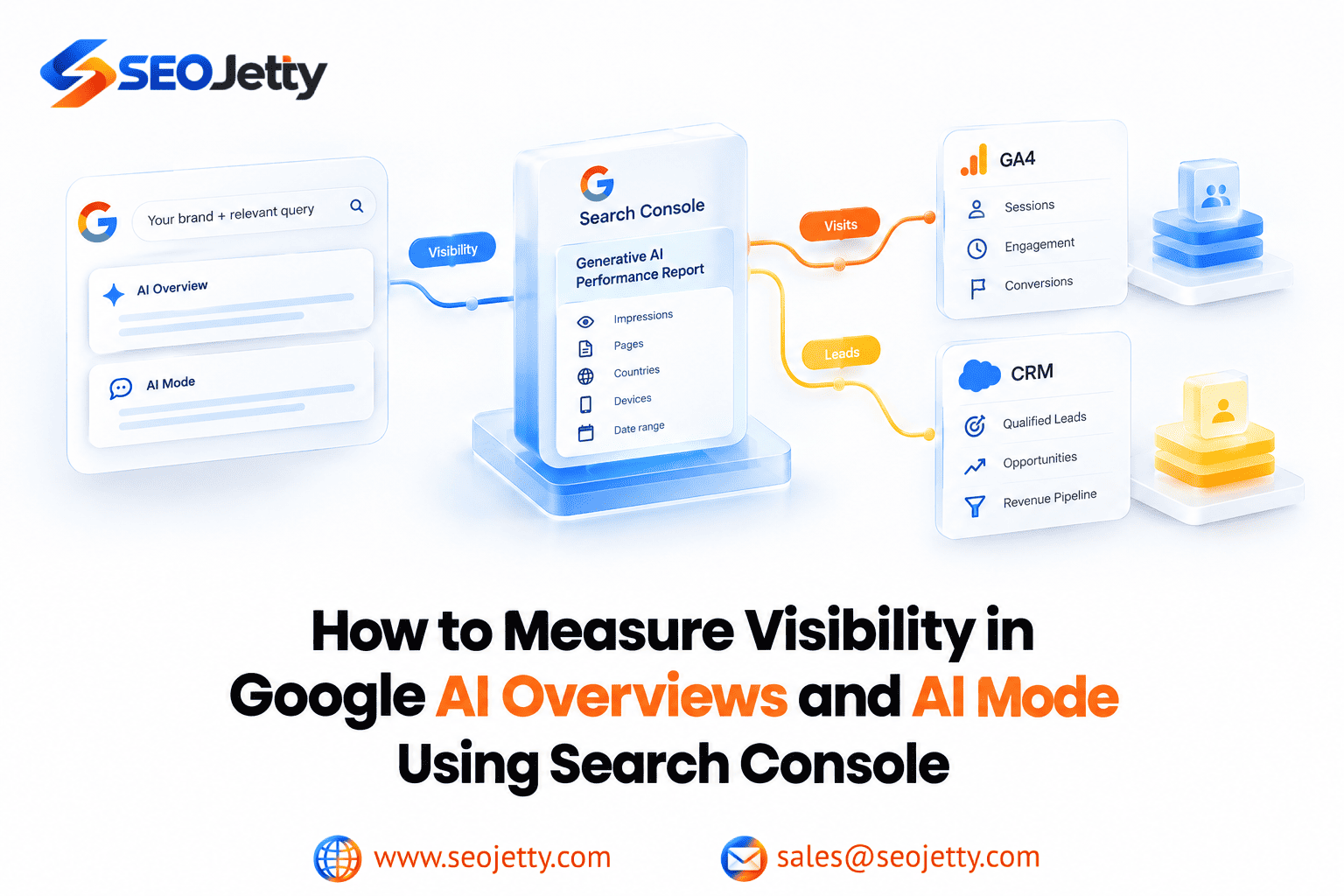
Google’s current generative AI search guide says special schema is unnecessary. Review its Search Console inclusion controls and Generative AI performance reporting alongside ordinary search eligibility. Do not assume a new markup format will secure citations.
For manual observations, define a modest set of actual buyer questions. Record the platform, date, language, country, browsing mode where relevant, and cited URLs. Repeat consistently enough to identify patterns while recognising that responses vary. A small prompt sample describes those observations; it does not measure your total market visibility.
When citations are missing, investigate access, relevance, factual clarity and the usefulness of the underlying source. Absence alone does not diagnose missing schema or weak authority. Track identifiable referral visits and qualified enquiries where possible, while documenting attribution gaps.
Turn findings into a prioritised action plan
Record one finding per row in a shared issue log. Include the affected URLs, evidence, proposed cause, confidence, business exposure, owner, effort, dependencies and validation method. Keep observations separate from conclusions.
Use three practical queues. These are planning recommendations, not a ranking formula:
- Restore access and functioning journeys. Address confirmed outages, accidental indexing restrictions and broken enquiry paths affecting important pages.
- Improve evidenced page weaknesses. Resolve intent gaps, confusing overlap, weak navigation and material usability problems.
- Test uncertain opportunities. Investigate hypotheses with limited evidence before committing substantial resources.
Within each queue, compare likely business exposure, confidence and effort. A rapid change affecting the whole site may need more testing than a slower change to one page. Do not confuse easy implementation with low risk.
| Finding | Decision | Validation |
|---|---|---|
| Live inspection confirms unintended noindex on a priority service page | Correct the instruction and check the shared template | Recheck live directives; monitor indexing separately |
| Two guides answer the same task with substantial overlap | Review consolidation after checking page-level traffic and links | Test redirects and links; track the surviving page |
| Mobile enquiries fail in a controlled form test | Repair the form and verify tracking | Complete submissions on affected devices; confirm receipt |
| One AI response omits the brand | Collect more observations before commissioning a fix | Maintain a consistent dated sample and note variation |
Check the implementation and the outcome separately
A fix can be implemented correctly without producing a measurable search gain. First confirm the intended change is live. Then monitor the affected page group against the baseline and, where practical, an unchanged comparison group.
Record concurrent changes and changes in demand. With small lead volumes, a few conversions can distort percentage changes. Report uncertainty and lead quality alongside totals. Set a review date based on the issue and available data; do not promise a universal recovery window.
Frequently asked questions
What access should I provide to someone reviewing the site?
Provide the reporting access needed for the agreed scope, typically Search Console and analytics, with relevant CMS or deployment information. Start with read-only access where possible. Share aggregated commercial outcomes rather than unnecessary customer-level records.
What if the website is too new to have useful traffic data?
Begin with access, indexing eligibility, clear page purposes and functioning conversion paths. Record an initial baseline and label performance conclusions as provisional. Limited history cannot show whether a change caused improvement.
Should I remove every page that receives no organic traffic?
No. A page may support customers, navigation, sales or compliance. Establish its purpose, indexing status and links before deciding to improve, consolidate, retain or remove it. Zero recorded search visits alone is insufficient evidence.
How should an international site extend this analysis?
Compare language and country variants separately. Review localisation, regional page availability, canonical consistency and relevant hreflang implementation. Equivalent pages can have different demand patterns; translated text alone does not establish market fit.
How often should the review be repeated?
Match the cadence to publishing volume, deployments and business exposure. Check critical journeys after releases, review performance regularly and revisit deeper issues when evidence changes. A monthly or quarterly planning cycle can be a starting recommendation, not a universal requirement.
When is specialist help useful?
Seek help when evidence conflicts, rendering is complex, a migration is involved or internal teams cannot implement and validate changes confidently. Ask for reproducible findings, named owners and clear verification steps rather than an unexplained health score.
Choose the next action your evidence supports
Start with one important page group and one clearly defined problem. Build the evidence, resolve confirmed barriers and measure what follows. This produces a more defensible investment decision than treating every crawler warning as equally urgent.
If you need support interpreting the findings, review SEO Jetty’s AI-powered SEO and content optimisation service and discuss a review scope suited to your site.