
Search experience optimization connects how buyers discover your business with what they can verify and do on your website. For a B2B team, that means coordinating search accessibility, useful content, credible evidence, and a clear next step across traditional results and AI-assisted discovery.
A buyer might encounter a supplier in Google, investigate a question in ChatGPT, and then visit the supplier’s documentation before discussing it with colleagues. Another buyer may start with a recommendation and use search only to check details. Your strategy should help either person make a decision.
The practical starting point is one important buying decision: identify its unanswered questions, improve the pages that should answer them, and measure what happens. Adding an AI label to the content plan does not establish that the information is useful or discoverable.
How SEO, AEO, GEO, and Search Experience Optimization Fit Together
These terms describe overlapping priorities. They are useful for planning, but they do not represent four independent technical systems with universal rules.
| Term | Planning focus | Practical application |
|---|---|---|
| SEO | Helping search engines access and understand useful pages, while serving the people who visit them. | Resolve indexing obstacles and improve an integration guide. |
| AEO | Making answers to specific questions clear and well supported. | Explain a deployment prerequisite and its exceptions. |
| GEO | Assessing and improving how a business’s information is represented in generative search experiences. | Check whether an AI answer accurately describes a product’s limitations and sources. |
| Search experience optimization, or SXO | Connecting discovery with comprehension, evaluation, and appropriate action. | Make it easy to move from an educational guide to technical evidence and a relevant inquiry. |
Here, GEO means Generative Engine Optimization, rather than geographic targeting. SXO also includes usability and the experience after a search visit; it is broader than combining SEO, AEO, and GEO deliverables.
Traditional search remains part of this work. Google says its established SEO practices apply to AI Overviews and AI Mode, with no special optimization requirement. That guidance applies to Google’s features; it should not be presented as documentation for every other provider.
Start With a Buying Decision and Its Evidence Gaps
Consider a hypothetical procurement team evaluating cross-border logistics software. Its initial question concerns data handling. Follow-up questions concern hosting regions, subcontractors, access permissions, integrations, and contract terms.
A broad article about security cannot substantiate every answer. The team may need a public architecture overview, product documentation, a current security statement, and a route to request contractual material. Sensitive details may appropriately remain behind an authorized review process.
Build a question-and-evidence map before commissioning more content:
- Decision: What must the buyer choose or rule out?
- Question: What information would change that choice?
- Evidence: Which document, demonstration, or accountable specialist supports the answer?
- Destination: Which existing page should contain it?
- Next step: What should someone do if the public answer is insufficient?
This is an illustrative planning method, not a claim about measured buyer behavior. Its value is that it reveals a specific content gap: a missing answer or missing proof. Neither requires publishing another generic overview.
Check Technical Access Before Rewriting Everything
An excellent page cannot help search visitors if the intended search system cannot access it. Use Google’s technical requirements as a starting point for Google discovery, then inspect the actual website.
The site owner should verify:
- The URL returns a successful response without unintended authentication or server errors.
- Robots.txt, indexing directives, and infrastructure settings reflect the intended access policy.
- The canonical identifies the preferred URL.
- Relevant crawlable pages link to the content.
- Sitemap entries use preferred, indexable URLs.
- Important content is present in the rendered page Google can access.
- Search Console URL Inspection and indexing reports have been reviewed.
A sitemap or indexing request can assist discovery; neither guarantees crawling, indexing, or ranking. Record the actual issue and its resolution rather than treating submission as proof of visibility.
Make Provider-Specific Crawler Decisions
Search access and model training access can have different controls. OpenAI’s crawler documentation distinguishes OAI-SearchBot, used for search, from GPTBot, which crawls material that may be used in training. A site owner can allow the former while disallowing the latter.
Ask the technical owner to review each relevant provider’s current documentation and the site’s actual responses. A blanket instruction to allow all AI bots is too broad. Access also does not establish that a page will be selected for a particular answer.
Build Pages That Help Buyers Verify Important Claims
Begin with the answer, explain its conditions, and make the supporting evidence easy to inspect. A product integration page, for example, should distinguish an available connector from a custom implementation that still requires engineering work.
For each important page, consider including:
- A direct explanation of what the product or service does.
- Prerequisites, exclusions, and operational limitations.
- Relevant documentation or appropriately scoped examples.
- A responsible author or reviewer where expertise matters.
- A meaningful review date when the subject changes over time.
- A next step that matches the reader’s remaining uncertainty.
Use headings, lists, and comparison tables when they make the subject easier to understand. A table can expose differences between deployment options; a paragraph may explain a tradeoff better. Formatting supports comprehension without guaranteeing selection by an answer system.
Retrieval-augmented generation describes combining retrieved material with generated output. Retrieval may involve a search index, documents, or another information source. It should not be assumed that every AI response searches the live web or uses the same source-selection process. Website publishing also does not give the publisher direct control over a provider’s retrieval pipeline.
Use Structured Data and Content Architecture With Clear Purposes
Structured data can describe page information in a machine-readable form. Follow the relevant structured data guidelines, represent visible content accurately, and validate the implementation. Choose types that fit the page rather than adding every available type. Correct markup does not guarantee a rich result.
Google documents no special schema requirement for its AI search features. Adding Organization, Service, Product, or FAQPage markup should therefore have an appropriate descriptive or supported feature purpose. It is not a prerequisite for an AI citation.
The same discipline applies to topic clusters. A service overview may usefully link to implementation requirements, integration documentation, and an evaluation guide. Each destination should resolve a distinct question.
Before creating a page, decide whether to:
- Update: Add missing evidence to a page that already answers the question.
- Consolidate: Combine overlapping pages into one stronger resource, with a technical migration plan where needed.
- Create: Publish a separate resource when the reader’s task and supporting material are meaningfully different.
Links should help a visitor understand the relationship between resources. Publishing many lightly varied pages does not prove authority. Google’s spam policies address scaled content created primarily to manipulate rankings with little user value, regardless of how it is produced.
Measure Visibility, Accuracy, and Commercial Activity Separately
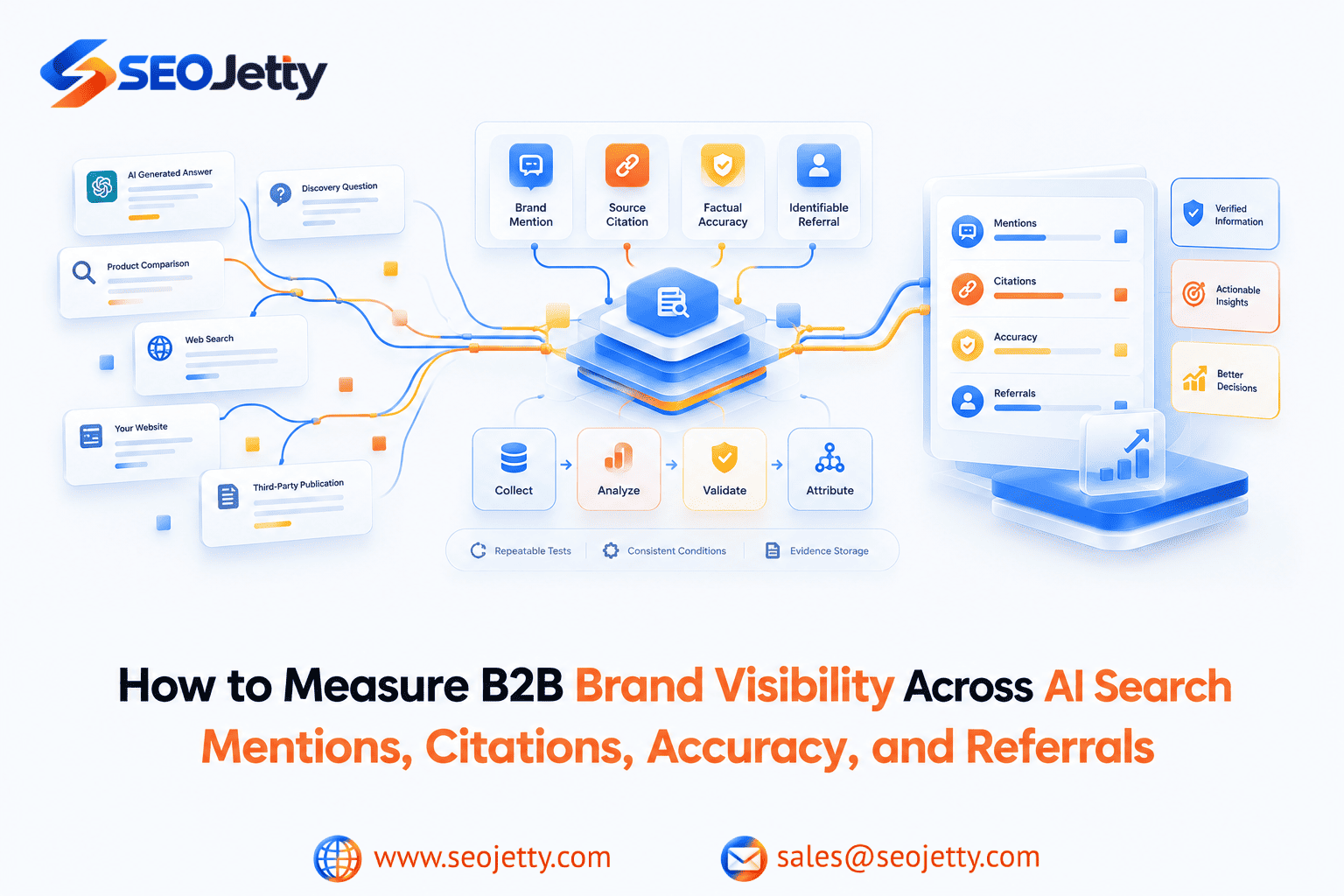
An AI citation shows that a source was referenced in an observed response. It is not automatically an endorsement, a visit, or a qualified lead. Keep the stages separate in reporting.
| Question | Evidence to collect | Interpretation limit |
|---|---|---|
| Can buyers find the page? | Search impressions, clicks, relevant queries, landing pages. | A position or impression is not a business outcome. |
| How is the business represented? | Recorded prompts, responses, brand mentions, cited URLs, factual errors. | A sampled response does not represent all users or queries. |
| Do visits support evaluation? | Identifiable referrals, documentation use, relevant inquiry events. | Tracking gaps and consent choices can limit attribution. |
| Do inquiries become opportunities? | Agreed qualification criteria, CRM source fields, opportunity records. | Observed association does not prove the content caused revenue. |
For AI response sampling, record the platform, available model or mode, search setting, exact prompt, date, language, and location where known. Keep an unchanged baseline set and repeat it under comparable conditions. Report the sample size and method rather than presenting an unexplained visibility score.
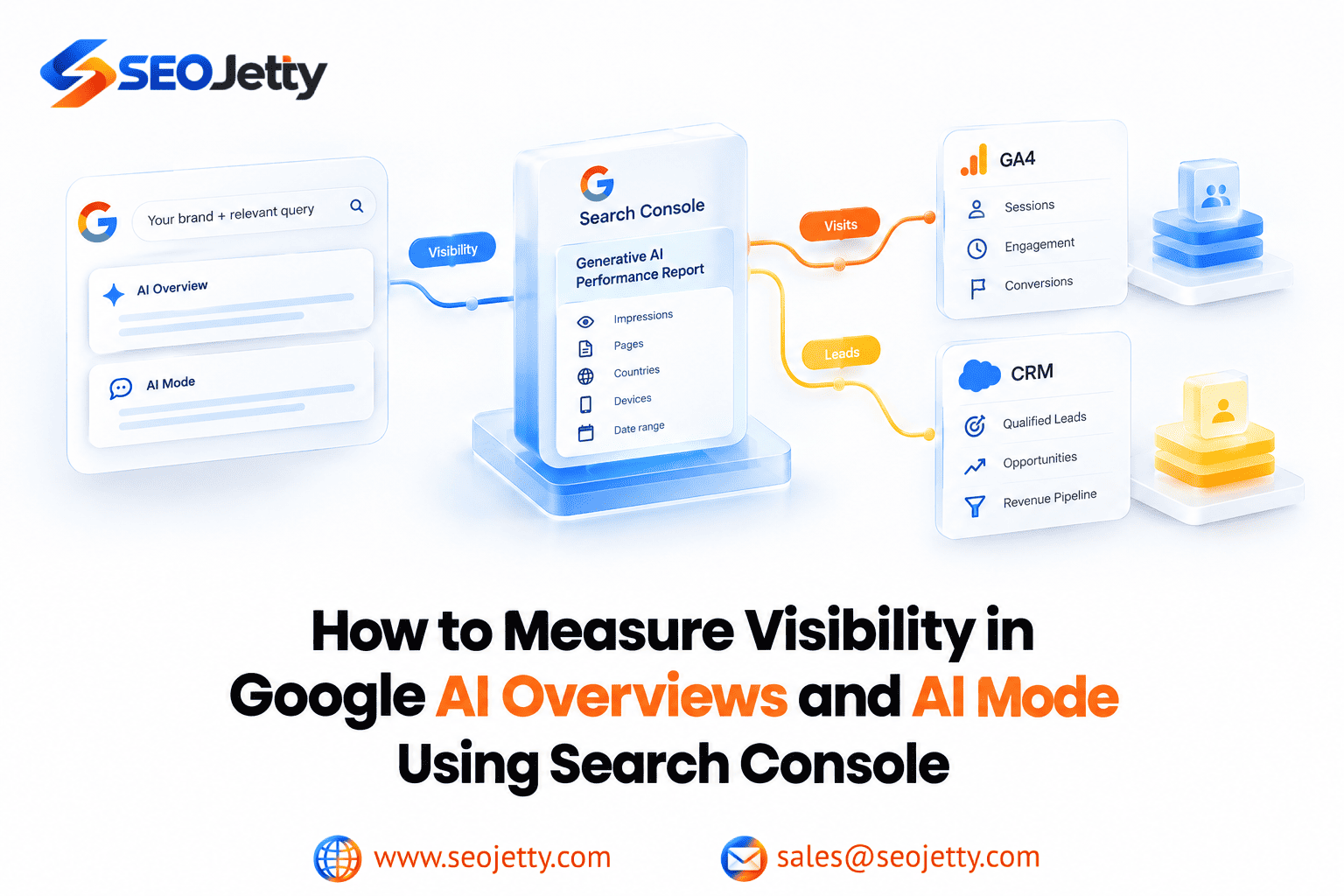
Google reports traffic from AI Overviews and AI Mode within Search Console’s Web performance data. Do not describe the standard report as a complete, separately attributed AI referral dataset. See Google’s AI features guidance for reporting context.
For a deeper reporting workflow, read SEO Jetty’s guide to B2B brand visibility across AI search. Define lead quality with sales before interpreting traffic changes as commercial progress.
Run a Focused Implementation Cycle
The following is a suggested working sequence, not a forecast of when results will appear:
- Choose the decision: Select one commercially relevant buying question and review existing coverage.
- Establish a baseline: Capture search performance, technical access, conversion tracking, and a small documented AI response sample.
- Fix the important gaps: Resolve access problems, clarify the answer, and obtain evidence from the accountable product or service owner.
- Improve the next step: Connect the page to documentation, evaluation material, or an appropriate inquiry path.
- Review and decide: Compare observations, note other changes that might explain movement, and decide what to improve next.
Assign a technical owner, content owner, subject reviewer, and measurement owner. One person may hold several roles, but every important claim and action needs someone responsible for it.
Frequently Asked Questions
Should an enterprise publish every technical detail publicly?
No. Agree on a public disclosure boundary with product, security, and legal owners. Explain the evaluation process and provide a clear route for requesting restricted evidence.
Should a PDF be replaced with an HTML page?
Choose according to the reader’s task. HTML can provide a convenient maintained summary, while a PDF can remain useful for downloadable specifications. Keep overlapping facts consistent and identify which version is authoritative.
How should teams handle inaccurate AI descriptions?
Save the response, prompt, date, and cited sources. Correct inaccurate information on pages you control, contact owners of incorrect external sources where appropriate, and repeat the observation later. A correction does not guarantee a provider will immediately change its output.
How often should the strategy be reviewed?
Set a cadence based on product changes, evidence availability, and reporting volume. Review consequential factual errors promptly. Avoid rewriting a page in response to one fluctuating answer.
Can one language version serve every international market?
Assess the audience’s language, purchasing requirements, and local evidence needs. Create a regional version only when it offers meaningful value beyond changing place names.
What should an agency proposal include?
Look for a defined baseline, access requirements, named deliverables, evidence review responsibilities, a sampling method, and reporting limits. Ask how the agency will decide between improving an existing page and commissioning another.
Connect Discovery With a Better Buying Experience
A useful search experience strategy makes important answers accessible, supportable, and actionable. Its priorities should come from the buyer’s decision and the business’s evidence, with results assessed through transparent reporting.
SEO Jetty lists SEO, AEO, and GEO among its services. If your team needs help coordinating this work, explore SEO Jetty’s search optimization services and discuss an assessment with a defined scope and measurement plan.