
To work toward getting cited by Perplexity, start with accessible public pages, useful answers to specific buyer questions, and evidence readers can verify. Then monitor whether those pages appear as sources. These are practical content and discovery measures, not a guaranteed citation formula.
For a FinTech marketing team, the task is more specific than publishing another industry overview. A payments buyer may need integration constraints; a banking technology buyer may need to distinguish product capabilities from regulatory obligations. Your content should make those decisions easier, whether someone finds it through Perplexity, conventional search, or a colleague.
What a Perplexity citation means
A citation links a response to a source page. It is different from an unlinked brand mention, and it should not be presented as an endorsement of your company, product, security, or regulatory status.
Perplexity’s official documentation describes tools for discovering and accessing web content. It does not provide a complete public scoring formula that lets a publisher predict citation selection. Recommendations about headings, original evidence, and related content should therefore be treated as useful editorial practices to test.
Decide what citation visibility would achieve
A source link can introduce a reader to your documentation or analysis. Whether that exposure produces useful visits or qualified enquiries must be measured. Do not assume citation traffic converts better than other traffic, or that a citation will generate a click.
Choose a concrete goal before investing: helping buyers discover an implementation guide, correcting confusion about a product capability, or making a published study easier to verify. Keep citation presence, referral visits, and commercial outcomes as separate measures.
1. Build a small set of real buyer questions
Collect questions from sales discussions, support issues, product documentation gaps, and customer research. Choose one product area and one audience first. A payments team might investigate:
- What happens when a webhook notification arrives more than once?
- Which reconciliation records does this integration export?
- What must a buyer verify before moving from a sandbox to production?
These are illustrative questions, not observations from a Perplexity study. Map each question to an existing page before commissioning content. Improve a useful page when it already answers the need; create a new one only when the reader’s task is distinct.
2. Give each answer an evidence trail
Make important statements checkable. For your own product, use maintained documentation and approved specifications. For external requirements, link to the relevant regulator or standards body and identify the jurisdiction, effective status, and review date.
Use an internal claim register with four fields: statement, supporting source, scope, and responsible reviewer. Mark unsupported statements for removal or verification. This is especially useful when marketing language mixes a product feature with a compliance conclusion.
For example, “exports a named audit record” and “makes the customer compliant” are different claims. Describe the documented capability, its limits, and the customer’s remaining responsibilities. Have a suitably qualified reviewer assess legal or regulatory interpretations before publication.
3. Add something a buyer can actually use
Originality does not require commissioning a large survey. Consider a reproducible integration walkthrough, a documented testing method, or a comparison based on explicit criteria. Explain what was examined and where the findings stop.
Hypothetical example: A payment software provider could publish a sandbox guide showing how its integration handles repeated notifications. The guide could disclose the test setup, software version, expected behavior, observed results, and exceptions requiring investigation. This would be a proposed resource, not evidence that the provider has run the tests or earned citations.
If you publish research, report the sample, collection period, definitions, and limitations. Do not turn internal impressions into industry statistics. Use approved, non-sensitive examples rather than exposing customer transactions or account information.
4. Make the page clear without reducing it to snippets
State the answer early, then explain its conditions. Use descriptive headings, meaningful link text, and tables when readers need to compare the same attributes. Keep qualifications beside the statement they modify.
For a pricing explanation, distinguish currency, billing period, applicable region, exclusions, and the date checked. For a feature comparison, distinguish generally available functionality from a roadmap item. A concise answer that omits a material condition can mislead even when it sounds confident.
Provide an accountable author or team, an appropriate reviewer, and a useful revision history. These choices help readers evaluate the work. They are not documented switches that force Perplexity to cite a page.
5. Check public access separately from content quality
Perplexity distinguishes PerplexityBot, which supports search discovery, from Perplexity-User, which supports user-triggered access. Its documentation recommends allowing PerplexityBot through robots.txt and relevant network controls. It also says Perplexity-User generally ignores robots.txt because requests are initiated by users.
Ask the site owner to inspect intended public URLs, server responses, redirects, and firewall challenges. Where bot access is allowed, verify both the user agent and current official IP ranges. Keep private financial systems and customer information protected; public documentation access does not require opening authenticated areas.
Successful access is not evidence of a citation. Likewise, a bot visit in a server log does not demonstrate that your page appeared in an answer.
Separate checklist for Google discovery
If the page also needs Google visibility, have the site owner verify:
- The preferred URL loads successfully and is accessible to Googlebot.
- Robots.txt, noindex directives, authentication, or server errors do not unintentionally prevent discovery or indexing.
- The canonical identifies the intended URL, and sitemap entries use that URL.
- Relevant crawlable pages link to it, and important rendered content is accessible to Google.
- Search Console URL Inspection and indexing reports have been checked.
Sitemaps and indexing requests do not guarantee crawling, indexing, or ranking. Google’s AI features guidance also says no special AI schema or new machine-readable file is required for its AI search features. That guidance concerns Google; it is not a statement of Perplexity’s selection rules.
6. Keep brand information and external contributions accurate
Use consistent product names, company descriptions, and availability information across your own pages and approved partner profiles. Make the relationship between a parent company, trading name, and product clear where relevant.
Contribute research or named expert commentary to relevant industry publications when it serves their audience. A useful mention can help people discover and evaluate your work, but a backlink is not proof of future Perplexity visibility. Avoid buying citation promises or distributing near-identical articles across directories.
7. Measure repeated observations
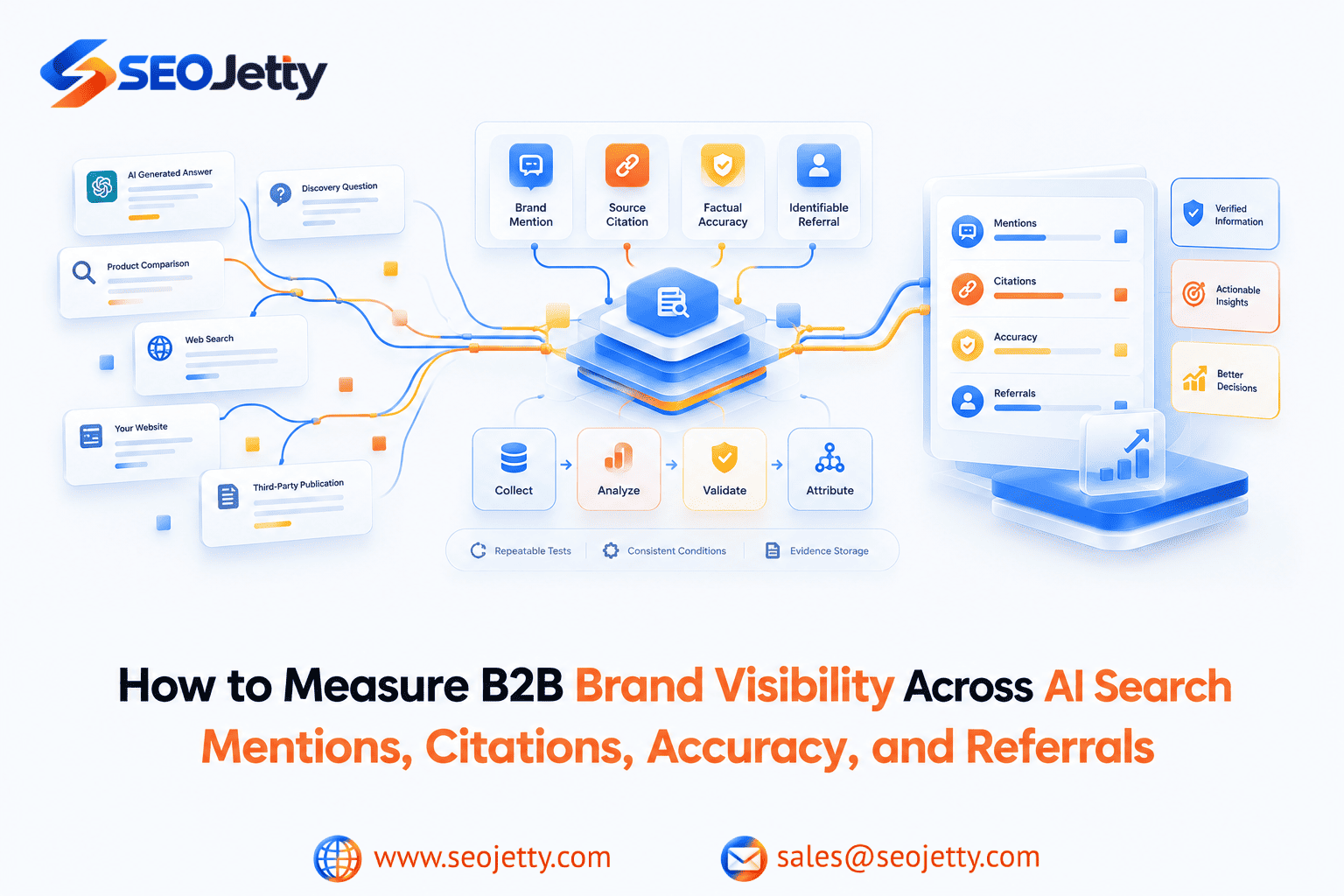
Start with a manageable question set, such as 15 buyer questions. Record a baseline before changing pages. Repeat the same questions on a defined schedule, keeping the test conditions as consistent as practical.
| Record | Purpose |
|---|---|
| Exact prompt, date, language, region, and visible mode or model | Document the conditions behind each observation. |
| Saved answer and cited URLs | Separate an actual source link from an unlinked mention. |
| Statement supported by the citation | Check whether the source was represented accurately. |
| Referral sessions and agreed conversion events | Evaluate observed visits and outcomes independently of citation presence. |
Calculate a sample citation rate as answers citing your domain divided by all recorded answers in the defined sample. Report the question set, dates, and repeat count alongside it. This is a sample result, not your share of all Perplexity answers. Missing referral data does not prove there were no citations.
Record content changes and inspect trends over repeated runs. A before-and-after difference alone does not prove the edit caused the change.
Mistakes to avoid
Do not replace evidence with repeated claims of authority, change dates without substantive review, or create many industry variants of the same generic guide. Avoid hidden instructions intended to manipulate answers and fabricated testimonials or expertise.
AI can assist research and drafting, but editors still need to verify facts and add reader value. Google’s generative AI guidance warns about producing many pages without added value. Its spam policies also address scaled content and manipulative links. These policies govern Google Search, not Perplexity citation selection.
Choosing support for the work
SEO Jetty advertises Generative Engine Optimization (GEO), Answer Engine Optimization (AEO), and SEO services. Its SEO service page includes technical and content architecture work. If evaluating support, request a scoped plan covering access checks, evidence review, existing-page improvements, and transparent measurement. No provider can promise Perplexity citations.
Additional questions
Should we remove a page that has never been cited?
Assess its usefulness, accuracy, and wider performance first. Absence from your sampled answers is not sufficient reason to delete a valuable resource.
Can a competitor’s comparison page count as our citation?
Count it as a third-party mention if it names you. Reserve owned-domain citations for links to your own pages, and report the categories separately.
Should every answer become a blog post?
No. A product document, support resource, or maintained pricing page may serve the task better.
Can we reuse the same test across countries?
Use a common core where appropriate, but separate results by market and language. Adapt questions when product availability or buyer needs differ.
What if a citation misrepresents our page?
Save the response and source URL, review the passage for ambiguity, and use available platform feedback tools. Correct your own content when needed.
Who should own ongoing maintenance?
Assign a content owner with access to product and subject specialists. Schedule reviews around meaningful changes rather than cosmetic date updates.
Start with one useful resource
Select a buyer question, improve the best existing page, verify its claims, check public access, and establish a baseline. Expand the work when the resource helps readers and your observations support the next investment. Treat citations as one visibility signal alongside accuracy, useful visits, and business relevance.