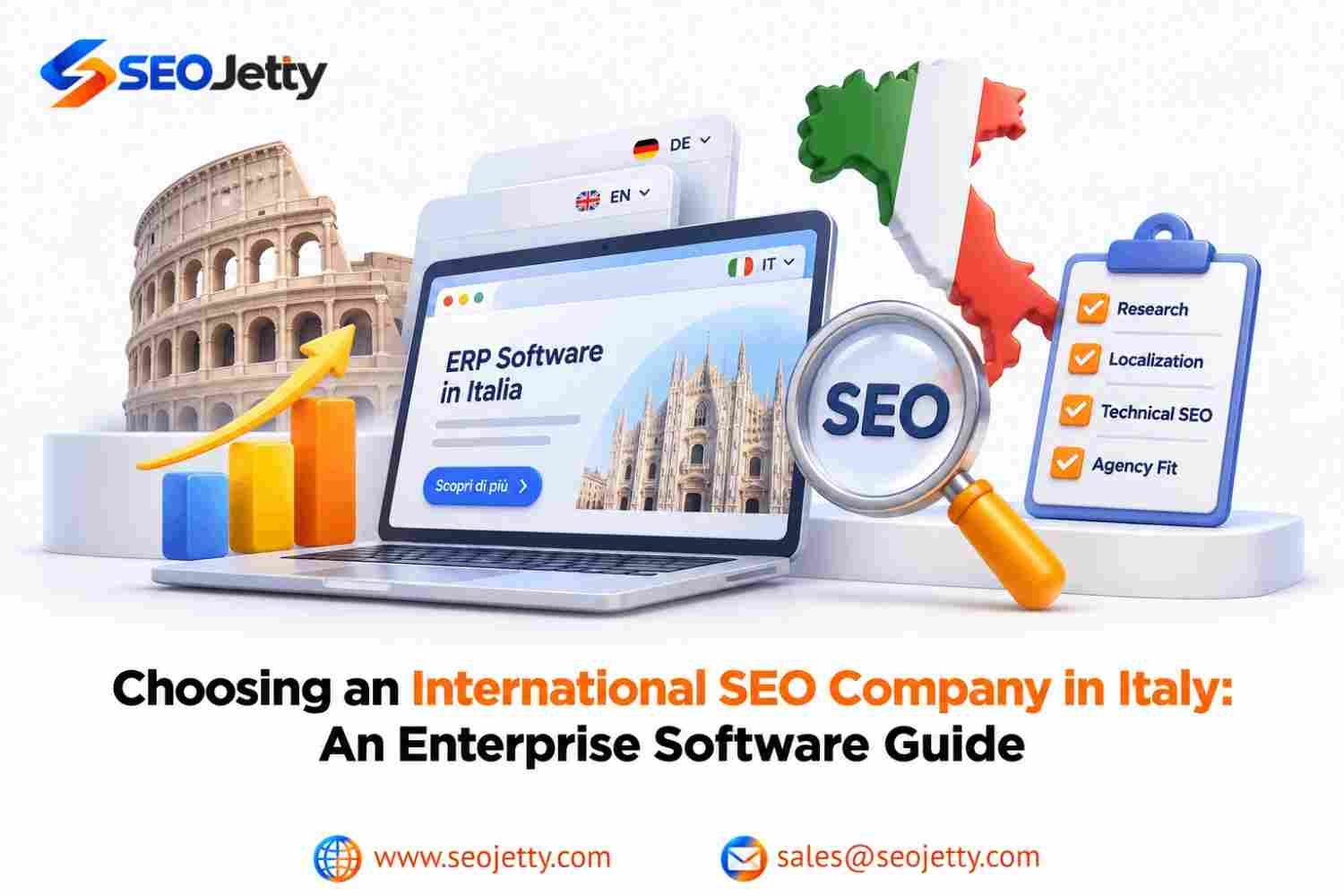
Choosing an international SEO company in Italy starts with a business decision: which Italian buyers can your software serve, and what information will help them evaluate it? Translating product pages is one part of that work. Your team also needs a manageable website structure, credible local content, and a way to connect organic discovery with qualified sales opportunities.
For enterprise software companies, a useful agency proposal should explain how those pieces fit together. This guide outlines what to research, what to implement, and how to evaluate a partner before committing to an international SEO program.
Define the markets and languages you actually need
International SEO coordinates organic search across countries and languages. Multilingual SEO addresses language versions; multi-regional SEO addresses country audiences. An Italian-language resource may serve readers across countries, while an Italy-specific product page may describe a particular commercial offering. Google explains these distinctions in its international website guidance.
The underlying SEO work remains familiar: accessible pages, useful content, clear navigation, and reliable measurement. International expansion adds decisions about localization, equivalent pages, ownership, and market-specific availability.
Before commissioning content, document:
- The industries, company sizes, and buying roles you want to reach in Italy.
- The products and integrations available to those customers.
- Italian-language sales, onboarding, and support capabilities.
- The next markets under consideration, such as Germany, France, or the United Kingdom.
This scope prevents a common operational problem: attracting inquiries that the business cannot support.
Build an Italy-specific research brief
Italy should not be treated as a uniform software market. Istat’s technology overview describes differing adoption patterns across cloud computing, electronic invoicing, data analysis, and artificial intelligence. That context supports segmenting research by application and customer type; it does not establish demand for a particular vendor’s product.
Research the buyer’s vocabulary
Start with Italian sales conversations, support questions, partner feedback, and existing search data. Build candidate terms around business tasks and product categories.
For an illustrative ERP research project, candidates might include “software gestionale,” “ERP per aziende manifatturiere,” and “integrazione ERP CRM.” These are starting hypotheses, not verified high-volume keywords. An Italian-speaking specialist should assess their meaning, search results, and suitability for the product.
For each useful query group, record the buyer’s task, the kinds of pages appearing in results, the evidence needed to answer the question, and the appropriate next step. Keep search-volume estimates separate from observed inquiries and conversions.
Localize the evaluation experience
Consider a hypothetical manufacturing software vendor. A translated feature list may explain inventory management, but a buyer may still need to understand implementation responsibilities, supported integrations, training, and Italian-language assistance.
A useful localized page addresses those questions using verified product information. Discuss invoicing workflows, hosting arrangements, or regulatory requirements only where they are relevant and reviewed by the appropriate specialists. Have a native Italian editor check terminology and clarity, then ask product and sales owners to approve factual claims.
Choose an architecture your team can maintain
Google recognizes country domains, subdomains, and subdirectories as international website structures. For an enterprise team already managing a shared platform, language or country folders can be a practical option, but migration costs and operational requirements should guide the choice.
For example, a company might use /it-it/ for Italy, /de-de/ for Germany, and /en-gb/ for the United Kingdom. Folder names are organizational choices; they do not replace localization or targeting annotations.
Give important locale versions stable URLs and provide visible language or country links. Avoid forced IP-based redirection that prevents people or crawlers from reaching another version. Make sure users can change their selection.
Map equivalent pages before adding hreflang
Hreflang identifies alternate language or regional versions of a page. It does not translate content or guarantee rankings. An illustrative mapping might connect an Italian ERP page with its equivalent German and UK pages.
Follow Google’s localized-page documentation: use supported codes such as it-IT and en-GB, fully qualified URLs, and reciprocal annotations that include each page itself. Use x-default where an appropriate fallback exists.
Review canonical signals alongside this mapping. Do not automatically canonicalize translated pages to English: Google does not treat fully translated main content as duplicate content merely because it conveys the same information. Keep unrelated pages outside the alternate set.
Turn recommendations into implementation work
An enterprise audit is useful when developers and content owners can act on it. Require each priority issue to include affected templates, an example URL, the proposed correction, an owner, and acceptance criteria.
For instance, “fix Italian navigation” is too vague. A workable ticket identifies the affected menu, explains the missing links, names the intended destinations, and specifies how the released version will be checked.
Use this technical checklist before launching a localized section:
- Priority URLs load successfully and are accessible to Googlebot.
- Robots.txt, noindex directives, authentication, and server errors do not unintentionally block access.
- Canonical URLs and language annotations match the intended pages.
- Relevant crawlable pages link to the new content.
- Sitemaps list the preferred indexable URLs.
- Important rendered content is accessible to Google.
- Search Console URL Inspection and indexing reports have been reviewed.
Sitemaps and indexing requests can assist discovery, but they do not guarantee crawling, indexing, or ranking. Include ongoing template checks in the release process so later CMS changes do not undo the implementation.
Create content around software evaluation
Prioritize pages that help a defined buyer make progress. A focused starting set could include a product page, a relevant industry page, an implementation guide, and an integration resource. Expand when research identifies additional needs and your team can maintain the information.
Useful evidence may include approved product screenshots, documented integration limits, implementation responsibilities, and customer examples published with permission. If Italian customer evidence is unavailable, clearly identify examples from other markets and explain their relevance.
Assign an owner and review date to each resource. Product availability, support arrangements, and integration details can change. Avoid publishing near-identical industry or location pages that all lead to the same generic explanation.
For outreach, prioritize contributions that have value independently of a backlink: technical research, expert commentary, partner education, or useful industry resources. Ask agencies to disclose paid placements and link practices before approving campaigns.
Approach AI search with testable claims
Google states that appearing in AI Overviews or AI Mode requires no special optimization beyond its established SEO practices. Its AI-feature guidance does not prescribe a special AI schema or a separate technical shortcut.
For software teams, the practical work is to make product information accurate, accessible, and understandable. Explain supported capabilities, cite evidence where useful, and keep technical resources current. These improvements help buyers assess the product; they cannot guarantee AI citations.
If an agency proposes AI visibility monitoring, require a defined platform, language, prompt set, observation date, and method. Treat the findings as a repeatable sample. Google includes its AI-feature traffic in Search Console’s overall Web performance reporting, so avoid presenting those totals as a dedicated AI channel.
Evaluate agencies using an evidence-based scorecard
When comparing an international SEO company in Italy with providers elsewhere, assess the people doing the work. Location alone does not establish Italian-language quality or enterprise delivery capability.
The following is a suggested procurement framework. Score each area from zero to five and calculate its weighted contribution as score divided by five, multiplied by weight.
| Evaluation area | Weight | Evidence to request |
|---|---|---|
| Italian research and editing | 25% | A sample intent brief and named language reviewers. |
| Enterprise technical delivery | 25% | An anonymized issue ticket, QA checklist, and release workflow. |
| B2B software understanding | 20% | A content plan addressing integration, implementation, and purchasing questions. |
| Measurement | 15% | A sample report connecting market-level activity to qualified inquiries. |
| Governance and transparency | 15% | Named owners, subcontractor disclosure, scope, and account access terms. |
Set minimum requirements before reviewing proposals. A strong aggregate score should not compensate for missing Italian editorial review or an unclear implementation owner. Request case studies with a baseline, timeframe, scope of work, and acknowledged limitations.
Agree on a practical first phase
A 90-day plan can organize delivery without becoming a promise of results.
- Days 1–30: Confirm the target segment, audit priority templates, establish measurement baselines, and approve the Italian research brief.
- Days 31–60: Resolve priority technical issues and publish a small set of reviewed pages.
- Days 61–90: Validate the release, examine early search and inquiry data, and decide what to improve or expand.
Track delivery separately from outcomes. Report completed fixes and reviewed pages alongside Italian search impressions, relevant clicks, qualified demo requests, and sales-accepted opportunities. Distinguish branded from non-branded activity, and avoid treating every visit from Italy as an Italian-language prospect.
Considering SEO Jetty
SEO Jetty advertises an International AI SEO service. Enterprise software teams considering that offering should request an Italy-specific scope covering language review, technical implementation, content ownership, and reporting. Ask SEO Jetty for a proposal addressing those requirements and evaluate it against the same evidence standards used for other providers.
Frequently asked questions
Should marketing pages and technical documentation launch together?
They can be phased. Start with the evaluation journey your team can support, and clearly identify documentation that remains available only in English.
Who should own the agency’s analytics accounts?
Your organization should retain ownership and administrator access. Give the agency the access needed for its agreed responsibilities.
What should an international SEO budget include?
Separate research, technical work, translation, native editing, product review, analytics, and ongoing maintenance. Confirm which costs are included and which require additional approval.
How should Italian demo requests be routed?
Agree on language, territory, qualification criteria, and response ownership before launch. Test form submissions through to the CRM and receiving team.
Can a pilot use machine translation?
It can support drafting, provided a qualified reviewer checks terminology, product accuracy, and usability before publication. Allocate review time explicitly.
When should the company expand into another European market?
Expand when delivery capacity, product readiness, and market evidence justify it. Use lessons from the Italian pilot, then conduct fresh research for the next market.
Choose a partner who can deliver the details
A useful international SEO partnership makes decisions concrete: which buyers to serve, which pages to build, who approves them, and how results will be assessed. Begin with a focused Italian program, require evidence from prospective agencies, and expand as your commercial and operational capacity develops.