Your website’s absence from a ChatGPT answer does not, by itself, reveal a technical fault or a content-quality problem. First establish whether the answer used web search, whether relevant pages are accessible, and whether those pages address the question being asked. Google rankings alone cannot answer those questions.
For a SaaS team, the useful next step is an evidence-based investigation. Otherwise, it is easy to spend weeks adding schema, publishing more blogs, or buying visibility reports without identifying anything that needs fixing.
This guide provides a practical diagnostic process. It distinguishes documented platform behavior from recommended checks, so your team can turn an observation into a specific action without assuming that any change will produce a citation.
Define what “not appearing” means
A founder asks for a shortlist of onboarding tools and does not see their company. A marketer asks about the same company by name and receives an accurate description. Another test returns a link to its documentation. These are different observations, not contradictory audit results.
Before diagnosing a problem, choose the outcome you are investigating:
- Brand mention: The answer names your company or product.
- Owned-site citation: A supporting source links to your domain.
- Third-party coverage: A cited external page discusses your business.
- Referral visit: Someone clicks through and the visit is identifiable in analytics.
A product mention is not necessarily a recommendation. A citation is not necessarily an endorsement. A missing referral is not proof that nobody saw the brand.
Also distinguish an ordinary answer from a search-backed answer. OpenAI explains that ChatGPT can search automatically or through a user-selected search tool. Search responses may show citations and a Sources panel. Review the evidence available in the response rather than assuming every answer has searched the live web.
Why a Google ranking does not guarantee a ChatGPT citation
A Google position describes a result for a particular search, location, and time. A conversational question can ask for a different task, such as evaluating a product against procurement constraints.
OpenAI documents that ChatGPT search may rewrite prompts into targeted queries and use search providers. Relevant saved memories and location can affect those searches. Consequently, comparing one Google query with one ChatGPT prompt is a limited test.
Keep platform rules separate. Google says its AI Overviews and AI Mode use established SEO foundations and require a supporting page to be indexed and eligible for a snippet. Those are Google’s requirements, not a published ChatGPT ranking formula. The two systems should be investigated independently.
Start with access before rewriting content
Check the right OpenAI crawler
OpenAI’s crawler documentation distinguishes OAI-SearchBot, used for ChatGPT search discovery, from GPTBot, used for potential model training. Their controls are independent: permitting training is not a prerequisite for permitting search.
OpenAI states that sites opting out of OAI-SearchBot are excluded from ChatGPT search answers, although navigational links may still appear. Its guidance recommends allowing that crawler and requests from its published IP ranges. ChatGPT-User handles certain user-triggered visits; successfully opening a URL on request does not establish search eligibility.
Ask the technical owner to review the rules affecting the exact page and inspect relevant server or firewall events. A security challenge, rate limit, or denied request is a concrete issue to investigate. Check request origins against the current published ranges rather than trusting a user-agent label alone.
Inspect what an unauthenticated visitor receives
Choose one important product page and one supporting documentation page. Open each without signing in. Can a reader find the product description, limitations, and integration details, or do they receive a login wall, consent barrier, error, or empty application shell?
Check the main text and links as well as the visual page. For Google, compare rendered content using its inspection tools and JavaScript guidance. Do not assume every crawler renders the site the same way.
Use a separate Google crawling and indexing checklist
These checks help diagnose Google discoverability. They do not prove ChatGPT access or guarantee an AI citation.
- Confirm that the preferred URL loads successfully and is accessible to Googlebot.
- Inspect robots.txt, page-level robots directives, authentication, and server errors for unintended restrictions.
- Confirm that the canonical points to the intended URL.
- Link the page from relevant, crawlable pages rather than leaving it orphaned.
- Ensure sitemap entries use the preferred indexable URL.
- Verify that important rendered content is available to Google.
- Review Search Console URL Inspection and page indexing reports; record the reported reason for any exclusion.
After a verified fix, a sitemap or indexing request can assist discovery. Google’s recrawl guidance makes clear that a request does not guarantee inclusion. Repeated submissions are not evidence that the underlying problem has been solved.
Compare the buyer’s question with the page’s actual answer
Once access checks are complete, assess the information itself. This is an editorial recommendation, not a claim about a hidden ChatGPT scoring system.
Consider a hypothetical SaaS buyer asking: “Which onboarding tools support Salesforce and require human approval before changing customer records?” A page saying “seamless integrations and intelligent automation” leaves the buyer’s important questions unanswered.
A useful page would explain:
- Whether Salesforce support exists and which records or operations it covers.
- Whether approval is mandatory, optional, or unavailable.
- Which plans include the capability and what setup is required.
- What happens after a rejected request or failed update.
- Where a reader can verify the behavior in maintained documentation.
Have a product specialist verify these details. If the feature is unsupported, say so. Accurate limitations are more useful than expanding a page with related terminology.
Use descriptive headings and direct explanations because they help readers navigate. Add a separate page only when the reader has a distinct task that the existing page cannot reasonably serve. A larger topic cluster is not automatically a better answer.
Make company and product facts easy to verify
Review your About page, product documentation, integration directory, pricing information, and contact details for contradictions. Explain relationships between the company, product names, and service categories in ordinary language.
If an external listing describes a retired product, request a factual correction through the publisher’s normal process. If a comparison page misstates an integration, provide a public source supporting the correction. Treat this as information maintenance, not a method of manufacturing third-party authority.
For content that makes a technical claim, identify the responsible author or reviewer and show supporting evidence where useful. Google’s people-first guidance asks publishers to consider originality, sourcing, and substantive value. It does not establish a universal formula for ChatGPT citations.
Keep schema and AI content claims in proportion
Structured data should describe what is visibly and accurately on the page. Check existing markup for errors and relevance before adding more types.
Google explicitly says no special schema or AI text files are required for its AI search features. Do not turn this into a promise about another platform, or interpret the absence of FAQ markup as an established explanation for a missing ChatGPT mention.
Likewise, the use of AI to draft content does not by itself establish a visibility problem. Google’s generative AI guidance stresses accuracy, quality, relevance, and review. Its spam policies address scaled content created to manipulate rankings without adding value, regardless of production method.
Review a draft for unsupported product statements, invented examples presented as real, and passages that repeat other pages. Improve the substance where necessary. There is no need to replace clear, accurate text solely because AI assisted its creation.
Build a diagnostic log your team can act on
Use the following as a proposed internal workflow, not a platform standard. Select a manageable set of real buyer questions and keep the core set stable while investigating.
| Observation | Evidence to collect | Next action |
|---|---|---|
| An important page receives denied crawler requests. | URL, timestamp, verified request source, response, and blocking rule. | Have the technical owner correct unintended restrictions and recheck. |
| A page is accessible but does not answer the buyer’s constraint. | The question, relevant page text, and approved product documentation. | Add the missing verified explanation to the most appropriate page. |
| A citation describes an outdated capability. | Saved answer, cited URL, and current product evidence. | Correct the owned source or request an external factual correction. |
| The brand appears in some sampled answers but not others. | Exact prompts, search setting, dates, language, location, and sources. | Report the observed variation before assigning a cause. |
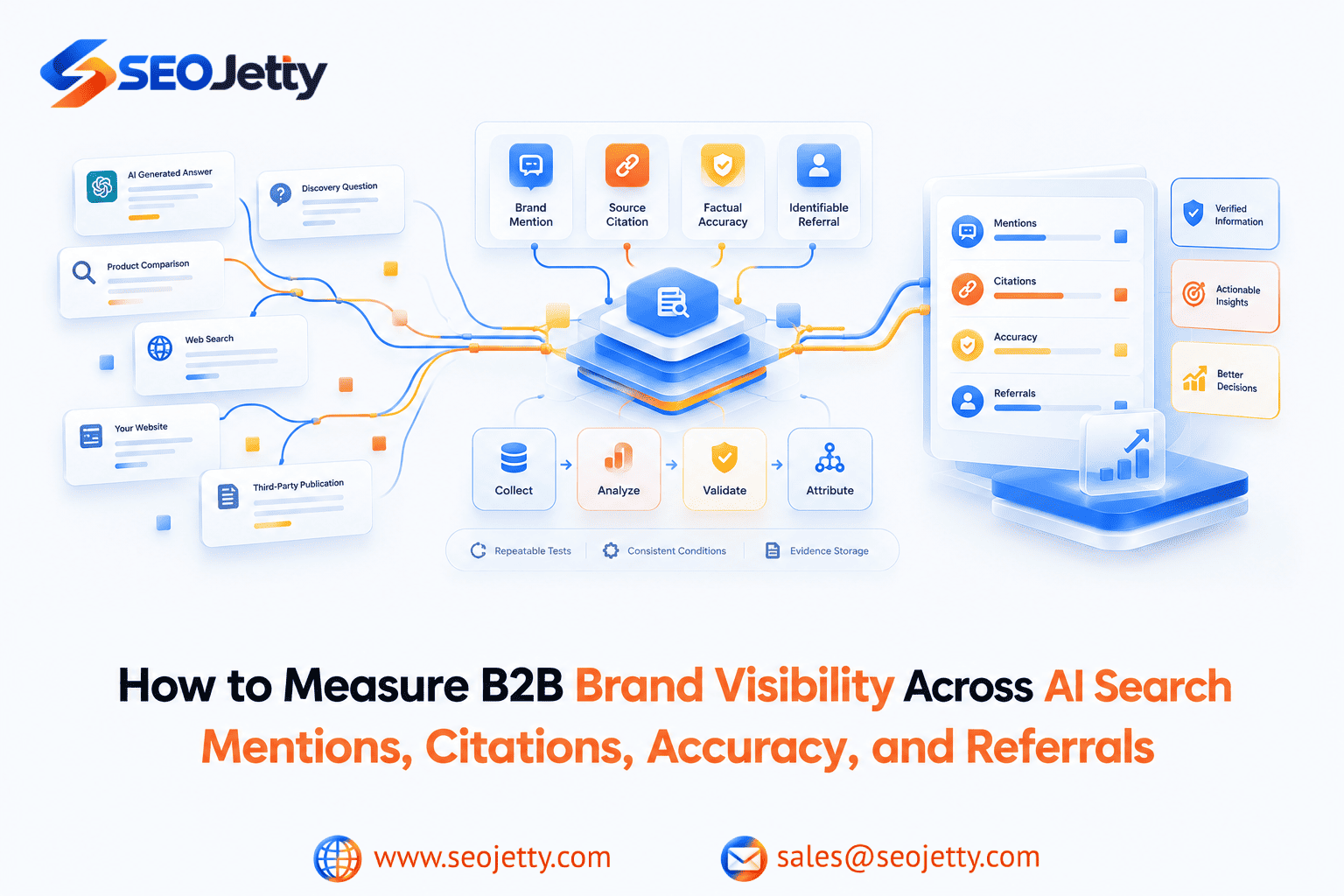
For each test, save the prompt, answer, cited URLs, date, and available environment details. Keep questions naming your company separate from unbranded discovery questions. Record mentions, citations, accuracy, and identifiable referrals separately; SEO Jetty’s AI visibility measurement guide expands on those distinctions.
After making a change, log exactly what changed and repeat the relevant checks. Describe results as observations within your sample. A before-and-after difference alone does not establish that your edit caused a citation.
Choose the next action from the evidence
If access is blocked, resolve the specific unintended restriction. If the page omits a buyer-critical fact, improve that explanation. If several pages repeat the same advice, consolidate them. If the only evidence is one missing mention, collect a more useful baseline before funding a broad rewrite.
If you need outside support, explore SEO Jetty’s SEO and Generative Engine Optimization services and ask for a scoped review tied to documented access, content, and measurement findings.
The goal is a website that people can access, understand, and verify, supported by a diagnostic record your team can use. Those are concrete improvements you can assess even when no platform guarantees your next appearance in an answer.