
Cybersecurity brands need public information that helps a buyer assess technical fit, operational limitations, and supporting evidence. That need applies whether someone reaches a page through a search result, an AI-generated answer, or a recommendation from a colleague.
AI Search Experience Optimization is a useful working label for reviewing that discovery experience. It should not become a promise that particular wording will win citations. The practical task is to make reliable information available, answer consequential buyer questions, and measure what happens after discovery.
For cybersecurity marketing teams, the starting point is an evidence inventory: which claims can the company substantiate, which questions remain unanswered, and who will maintain the material?
What AI Search Experience Optimization means
In this guide, the term means improving the accessibility, usefulness, and accuracy of content that people may encounter through AI-assisted search. It is an editorial and SEO planning concept, not a universal technical standard or certification.
Related terms include Answer Engine Optimization (AEO) and Generative Engine Optimization (GEO). Here, GEO means Generative Engine Optimization, not geographic targeting. Providers use these labels differently, so evaluate the actual work proposed.
Google states that established SEO practices remain relevant to AI Overviews and AI Mode, with no additional technical requirements or special optimizations needed. Its AI features guidance also makes clear that eligibility does not guarantee inclusion. Other platforms require separate assessment; Google’s guidance does not describe every answer engine.
Why cybersecurity brands should review the experience
An incomplete explanation can leave a buyer with the wrong impression of a security product. A claim about detection coverage may omit supported environments. A compliance statement may blur the distinction between a product feature and an organization’s responsibilities. An AI summary can introduce another point at which that context is lost.
Reviewing public content is therefore worthwhile even without assuming any particular level of AI adoption among CISOs. Ask whether a reader can identify what the product does, what evidence supports the claim, and what remains outside its scope.
Start with questions already appearing in sales discussions, support requests, and procurement reviews. These provide a defensible basis for prioritization. Avoid treating a popular prompt list as proof of buyer demand.
Build a cybersecurity content evidence matrix
Before commissioning more articles, connect each important buyer question to an evidence source and an accountable reviewer. The following is a suggested planning template, not a claim about any vendor’s capabilities.
| Buyer question | Useful public evidence | Recommended reviewer |
|---|---|---|
| Will this work in our environment? | Supported platforms, integration prerequisites, deployment options, and known exclusions | Product or solutions engineering |
| What supports the detection claim? | Test method, product version, conditions, and limitations for any published result | Security research lead |
| What data does the service handle? | Approved explanations of data flows, storage options, retention, and access controls | Security and privacy owners |
| Does this address our assurance needs? | Current assurance documents with their scope and applicable entity identified | Compliance owner |
| What will implementation require? | Configuration dependencies, customer responsibilities, and escalation boundaries | Implementation or support lead |
Keep confidential evidence in an appropriately controlled process. A public page can explain how an eligible buyer requests an assurance document without exposing sensitive configurations or restricted reports.
Write answers that retain technical context
Define the question before choosing a format
A definition page, integration guide, and vendor comparison solve different problems. Choose the format that helps the reader complete the task. A deployment question may need prerequisites and troubleshooting detail; a comparison may need a table with explicit criteria.
Provide a direct explanation, then the qualifications needed to interpret it. There is no universal answer length. Do not remove necessary caveats to make a paragraph look easier for an AI system to extract.
Make terminology precise
Expand acronyms such as endpoint detection and response (EDR) on first use. Distinguish a product category from a specific capability, and connect claims to documentation. Repeating security terminology does not substitute for explaining an actual implementation.
For example, NIST SP 800-207 describes zero trust as an approach focused on users, assets, and resources, without implicit trust based solely on location or ownership. A product page should explain which parts of that approach it supports instead of implying that buying one tool completes a zero trust architecture.
Show the basis of technical claims
If publishing a benchmark, state the methodology, environment, version, and limitations. If describing an integration, link to the supported configuration and distinguish generally available functionality from planned work. Attribute external findings to the original publisher.
Google’s people-first content guidance encourages reliable information and clear evidence of who created it. A named reviewer can help readers assess responsibility; a byline alone does not establish technical validity.
A worked example: improve a cloud security answer
Consider the hypothetical buyer question: “What access does your cloud security service need to assess our environment?” A vague answer might describe the service as secure and easy to deploy, leaving the actual decision unresolved.
A useful response would identify the supported cloud environment, the permission model, the documented onboarding steps, and the checks the customer should perform. It would distinguish assessment access from any permission to change resources, if that distinction applies to the product.
- Gather the facts: Ask the integration owner to verify the access requirements against the current release.
- Publish the boundaries: Explain what the integration can read or change, its dependencies, and where the customer can inspect the configuration.
- Support evaluation: Link to the relevant setup documentation and describe where to ask a technical question.
- Assign maintenance: Update the answer when permissions or onboarding behavior change.
This example is a content design recommendation, not a tested ranking intervention or a description of SEO Jetty client work. Its value is that a buyer has more concrete information for an access review.
Keep technical SEO proportionate
Use descriptive headings, readable HTML, and relevant internal links. Keep important explanations available as text rather than only in a screenshot. Give readers a clear route from an overview to the documentation that resolves their question.
Google’s generative AI search guidance rejects the need for special AI markup or a prescribed writing format. Use structured data when it accurately describes supported page content; do not treat it as an AI citation mechanism.
For cybersecurity sites, coordinate public-page access rules with the teams responsible for authentication and web application protection. Investigate unintended restrictions on marketing content without weakening controls on private portals or customer data.
Maintain regional accuracy and review ownership
For international audiences, check whether a page’s product availability, support arrangements, and document references apply to the market addressed. Translation should preserve technical meaning and qualifications. Obtain qualified review for jurisdiction-specific statements rather than copying a global compliance claim into every language.
A practical governance record should include an owner, evidence location, reviewer, review date, and update trigger. Triggers can include a product release, changed integration permissions, withdrawn assurance document, or a correction to a cited source.
AI can assist with outlining or identifying inconsistent terminology, but a responsible reviewer must verify the facts. Google’s generative AI content guidance emphasizes accuracy and warns about producing many pages without added value.
Measure discovery separately from business results
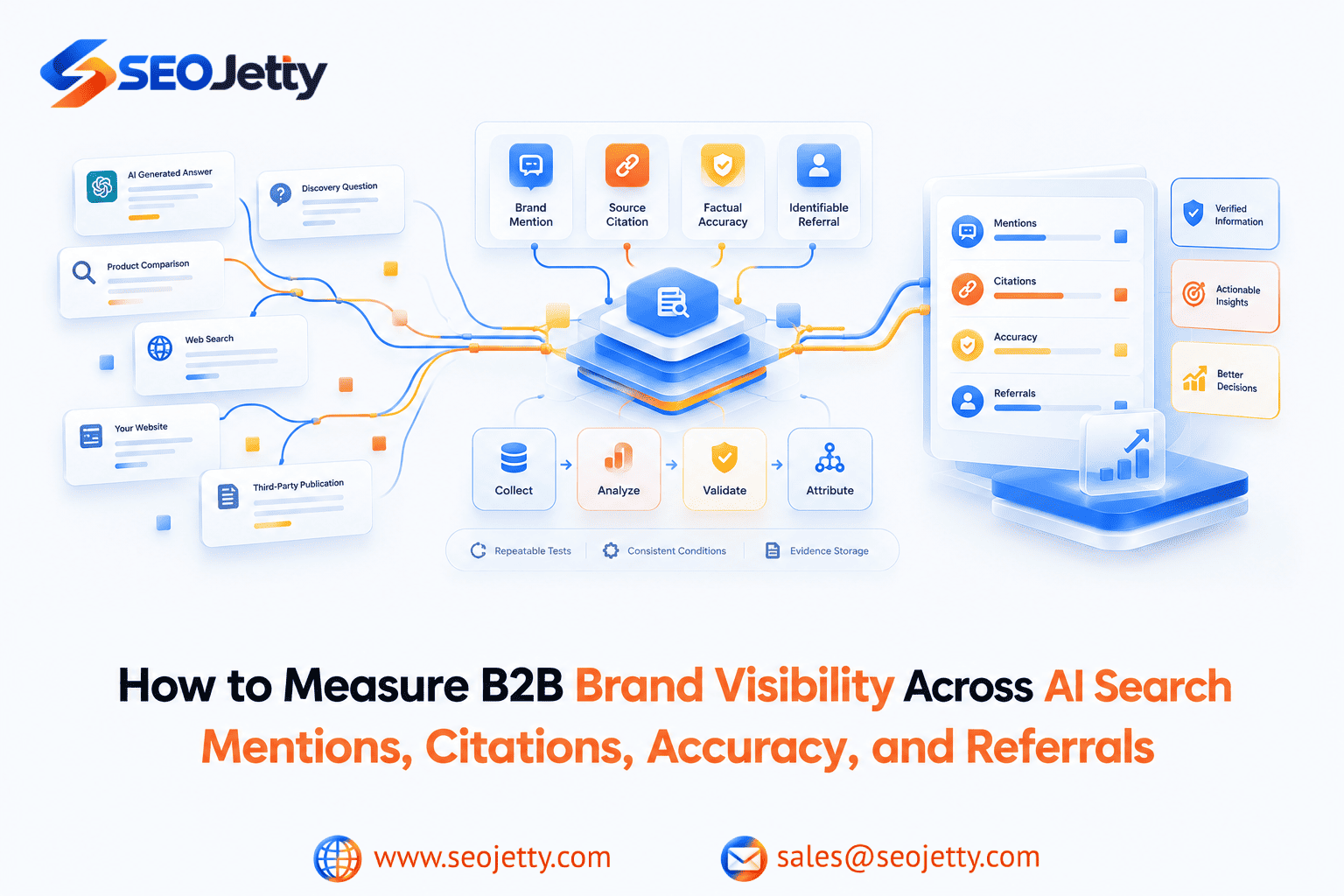
Set a baseline before changing content. Combine search performance, identifiable referral visits, engagement with technical material, and qualified inquiries. Record analytics limitations so the team does not interpret missing referral information as proof of no influence.
If sampling AI-generated answers, keep a stable question set and log the date, platform, language, market, and conditions. Distinguish a brand mention from a citation and a citation from an actual visit. Repeat observations; a single response is a snapshot.
Track whether summaries represent the product accurately, especially its exclusions and deployment requirements. Agree on a correction process when public documentation is ambiguous. Changes in a small prompt sample are not proof that an edit caused a commercial outcome.
A manageable implementation sequence
- Inventory: Select one important buying task and review existing pages, buyer questions, and evidence gaps.
- Resolve: Fix unclear or unsupported claims and unintended access problems before expanding content.
- Improve: Update the strongest existing resource with reviewed explanations, useful evidence, and relevant links.
- Evaluate: Compare observations with the baseline, examine qualified inquiries, and decide what needs further work.
SEO Jetty’s official website lists AEO, GEO, SEO and content optimization, and international SEO among its offerings. If outside support is needed, discuss a scoped content and SEO review with SEO Jetty, including technical review responsibilities and measurement limits.
Frequently asked questions
Should detailed security documents always be public?
No. Let the document owner determine access. Public explanations can support evaluation while restricted evidence is shared through an approved buyer-review process.
Should every buyer question become a separate page?
No. Add an answer to an existing resource when it serves the same task. Create a separate page when the reader needs a distinct, substantial resource.
What should a team do if it lacks original benchmark data?
Explain verified functionality and limitations. Link to relevant external evidence with attribution, and avoid presenting it as the company’s own test.
Who should approve a vendor comparison?
Assign reviewers familiar with the products and the claims being made. Use current documentation, consistent criteria, and clearly stated uncertainty where features cannot be verified.
How often should a prompt sample change?
Keep a stable core for comparison. Add questions when buyer needs change, recording when and why the sample changed so the results remain interpretable.
Does adding “2026” make an article current?
No. Review the evidence and substantive guidance. Display an update date only after a meaningful review or revision, and retain a maintenance owner.
Build the strategy around evidence
Choose a consequential buyer question, publish a substantiated answer, and assign someone to keep it accurate. Combine that work with accessible pages and careful measurement. Cybersecurity brands can then evaluate AI-assisted discovery as part of a broader SEO strategy, without confusing visibility with verified technical credibility or revenue.