
For a SaaS company, building authority for AI search starts with making important product and category claims easy to find, understand, and verify. Combine accessible pages, useful buyer guidance, documented product evidence, and credible independent coverage. Then measure what appears in search and whether visitors take meaningful business actions.
This is a practical operating approach, not a formula for getting recommended. A search system may cite an educational page without recommending its publisher, mention a vendor without linking to it, or omit a suitable product entirely. Your team needs to understand those differences before choosing its next content investment.
What Does AI Search Authority Actually Mean?
In this guide, AI search authority means the strength of the publicly available evidence around your company and its subject matter. It is a planning term, not a universal score supplied by Google, ChatGPT, Gemini, or Perplexity.
Three questions make the idea actionable: Can people find your information? Can they verify your claims? Does the information help them make a decision? Traditional SEO already addresses these concerns. AI-assisted discovery adds another place to observe how your information is represented.
For Google specifically, the official AI-feature guidance says existing SEO practices remain relevant and no special optimization is required. Supporting pages must be indexed and eligible for snippets. Meeting the requirements does not guarantee inclusion.
Use Generative Engine Optimization (GEO) and Answer Engine Optimization (AEO) as descriptions of work, with explicit deliverables. A proposal should explain which pages, evidence gaps, access issues, and measurements it will address rather than promise an undefined increase in authority.
Step 1: Choose a Buyer Decision You Can Support
Start with one product category, buyer role, and priority market. Trying to cover every adjacent topic usually makes it harder to judge which work matters.
Consider a hypothetical workflow SaaS company serving midmarket operations teams. Its initial focus might be approval software for teams using a particular CRM. Useful questions include how permissions work, what happens when synchronization fails, and whether approval history can be exported.
Collect questions from sales calls, support records, product documentation, and customer interviews, using approved information. Group them by decision stage: understanding the problem, evaluating fit, assessing implementation, and validating risk.
Choose questions using three criteria: relevance to the product, importance to the buyer, and availability of reliable evidence. A question that sounds commercially valuable but cannot be answered accurately is an evidence-gathering task before it is a publishing task.
Step 2: Build an Evidence Inventory Before a Content Calendar
Create a shared register linking important claims to their supporting material. Record the claim, source, responsible owner, applicable plan or region, review date, and public destination.
- Product capabilities: Link feature claims to maintained documentation or a reproducible demonstration.
- Integrations: Document supported versions, permissions, data direction, limits, and failure handling.
- Implementation: Describe dependencies, responsibilities, and constraints without promising a standard completion time.
- Customer outcomes: Use approved evidence with a baseline, measurement period, scope, and limitations.
- Security and compliance: Publish statements reviewed by the responsible team and explain what any certification actually covers.
Keep confidential material private. Public evidence can explain the method and boundaries without exposing customer records, internal architecture, or sensitive configuration.
If a claim has no reliable source, remove it or investigate it. Repeating an unsupported statement across your homepage, blog, and directory profiles does not turn it into corroboration.
Google’s people-first content guidance encourages original information, useful analysis, and value beyond rewriting other sources. Your evidence register helps editors identify where that contribution can come from.
Step 3: Map Questions to Pages With Distinct Jobs
Build a content map around what readers need to accomplish. A cluster is useful when its pages resolve different questions and connect naturally; the number of URLs is not the objective.
| Buyer question | Page job | Evidence to include |
|---|---|---|
| Does this support our approval process? | Explain product fit and limitations | Supported rules, permissions, and an example workflow |
| How does the CRM integration work? | Help a technical evaluator assess feasibility | Setup steps, field mapping, access requirements, and error handling |
| What will the subscription cover? | Explain commercial scope | Current plan limits, billing basis, and optional charges |
| How can we validate it before rollout? | Support a pilot decision | Acceptance criteria, test scenarios, and ownership checklist |
Link the product page to the integration guide where integration is discussed. Link pricing to its definition of billable usage. Link an implementation article to relevant documentation. These connections should help a reader complete the next task.
Audit existing pages before adding new ones. If two articles answer the same question with the same evidence, improve the stronger resource and decide how to consolidate the other. Do not create separate pages merely because a keyword tool lists several phrasings.
Step 4: Make Product Information Precise and Maintainable
Write the answer early, then explain its conditions. For an integration page, “supports CRM integration” tells a buyer little. Explain whether synchronization is one-way or two-way, which records are supported, and what requires manual intervention.
Use clear product names and distinguish the company, product, individual features, and external partners. Keep public descriptions accurate across your website and profiles you control. Treat this as information governance rather than a promise of knowledge-graph inclusion.
Add authorship and technical review where they help readers assess the material. Name reviewers only with permission and describe actual responsibilities. A decorative biography cannot substitute for accurate instructions.
Assign a maintenance trigger to each high-value resource: a pricing change, integration update, policy revision, or product release. An article can be well written and still mislead if its plan restrictions are obsolete.
AI can help organize source material and draft explanations. Google’s generative AI content guidance emphasizes accuracy, relevance, and manual review. Have the responsible product or subject expert verify the final claims, including metadata.
Step 5: Check Discoverability and Platform Access
Useful content needs an accessible publication path. Ask the site owner to verify the following for priority URLs:
- The page loads successfully without unintended authentication or server errors.
- Robots.txt, indexing directives, and infrastructure rules permit the intended search access.
- The canonical points to the preferred version.
- Relevant pages provide crawlable internal links.
- Sitemaps list the preferred indexable URL.
- Important rendered text is available to Google.
- Search Console URL Inspection and indexing reports have been reviewed.
A sitemap or indexing request can assist discovery but cannot ensure crawling, indexing, or ranking. Address the underlying access or quality issue rather than repeatedly submitting the same URL.
Keep any structured data consistent with visible content. Google does not require special AI schema or an AI text file for its AI search features. Validate markup used for supported search features without treating successful validation as a citation guarantee.
Review other platforms separately. OpenAI distinguishes OAI-SearchBot for search from GPTBot for model training, with independent controls. Allowing training access is not a prerequisite for search access. Have the technical owner evaluate crawler settings against the company’s publishing policy and current platform documentation.
Step 6: Develop Independent Evidence Without Manufacturing It
Third-party coverage can help buyers investigate a vendor beyond its own marketing. Its editorial value depends on accuracy and relevance; do not assign every mention an assumed AI-ranking benefit.
Start with places your actual buyers use: a relevant integration marketplace, specialist publication, professional community, or review platform. Correct outdated product information where you have permission. Let independent publishers retain editorial control.
Offer something useful to examine, such as a documented migration checklist, a transparent research dataset, or an expert explanation of a difficult implementation tradeoff. If publishing research, disclose the sample, collection method, exclusions, and date.
Ask customers for honest feedback within each platform’s rules. Avoid scripted endorsements, fabricated experiences, or incentives tied to positive sentiment. An authentic review describing a limitation may be more useful to an evaluator than another vague testimonial.
Google’s spam policies address manipulative link practices. Avoid buying links that pass ranking credit, automated link placement, and low-value publishing campaigns designed around link quotas. Measure whether coverage informs relevant readers instead of counting placements alone.
Step 7: Expand Internationally Where the Product Is Ready
Global visibility requires decisions about markets, languages, and operational support. Before localizing, confirm where you can sell, onboard, support, and contract with customers.
For the hypothetical workflow product, an Australian buyer may need support-hour information; a German evaluator may need German documentation and verified information about available hosting arrangements. Publish only facts the business can substantiate.
Prioritize one market with meaningful demand and product readiness. Adapt examples, terminology, commercial details, and support information with qualified local review. Treat Europe as multiple markets with different languages and buyer needs.
Google recommends separate URLs for language versions and explains how hreflang can identify alternatives. Coordinate locale annotations, canonical decisions, and navigation with your technical team.
Avoid producing country or city variants that merely replace place names. Build a separate resource when the reader needs materially different information. Useful localization requires editorial work beyond machine translation.
Step 8: Measure Observed Visibility and Business Value Separately
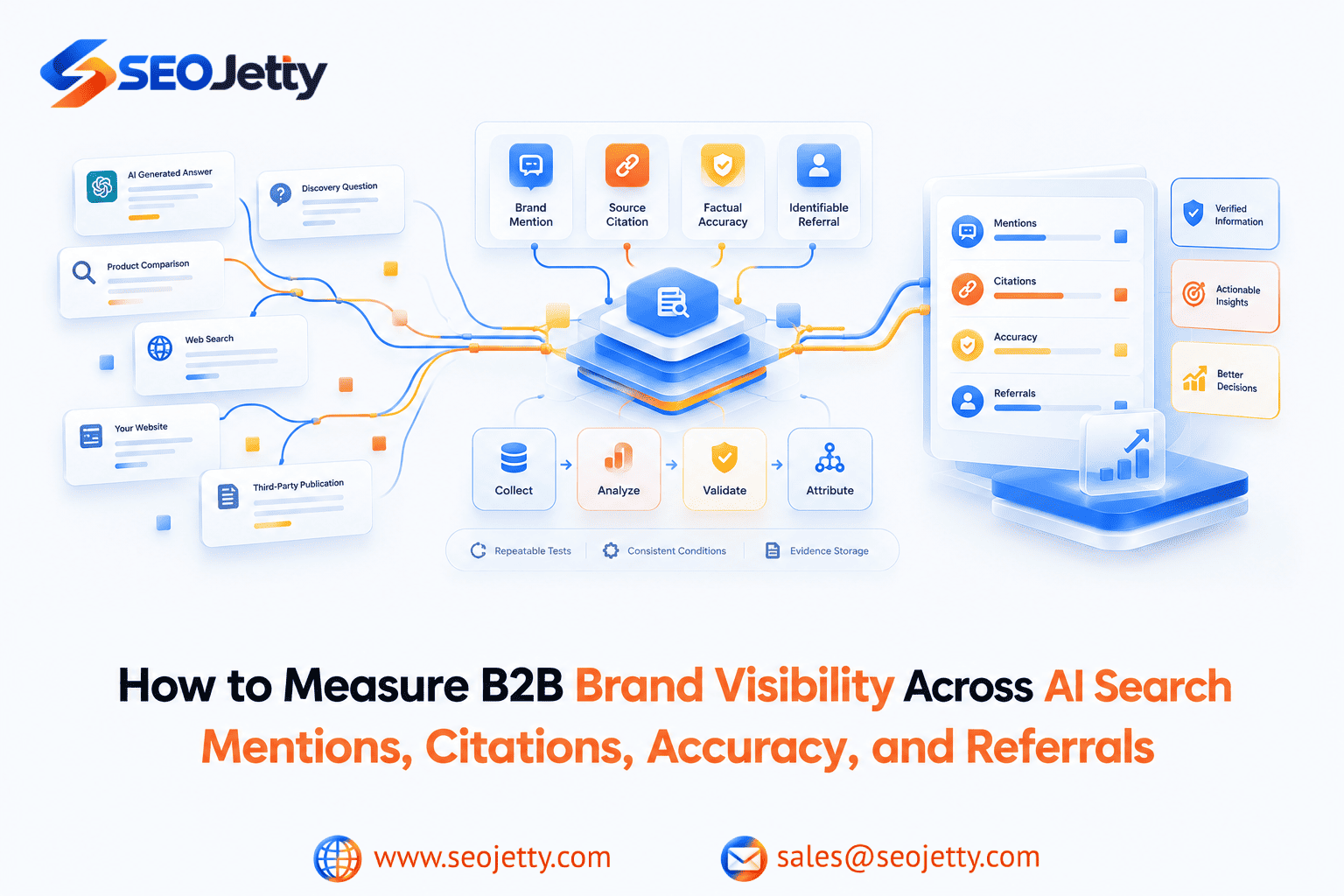
Create a repeatable sample of questions from your chosen buyer decision. Separate unbranded category prompts from prompts naming your product: a named-product question tests representation, not unaided discovery.
For each observation, record the exact prompt, date, platform, visible model or mode, language, location settings where available, and cited URLs. Save the answer and note whether search was active. Repeat under similar conditions while acknowledging that outputs may still vary.
Classify outcomes separately: brand mentioned, owned URL cited, product recommended, or factual error observed. A citation to your educational article does not necessarily mean the system endorsed your software.
A simple sample citation rate is the number of recorded answers containing an owned URL divided by all recorded answers in that sample. State the denominator, number of repeats, and collection method. Call it a sample observation, not total market share.
Google reports AI-feature traffic within Search Console’s overall Web performance data. Do not label all organic-search movement as AI-driven. Review analytics referrals, landing-page engagement, qualified demo requests, and pipeline records alongside visibility observations.
If citations increase while qualified enquiries remain flat, investigate audience fit and landing-page usefulness. If revenue improves after several simultaneous changes, avoid assigning the entire gain to AI visibility. Use the evidence to guide decisions without claiming causality you have not tested.
A Practical First Implementation Cycle
Organize the work by dependencies rather than a promised results deadline:
- Establish the baseline: Agree on one buyer decision, inventory existing pages, and capture initial visibility observations.
- Repair the evidence: Resolve unsupported claims and update the documentation buyers need most.
- Improve access and navigation: Fix confirmed technical obstacles and connect useful resources.
- Publish or consolidate: Fill distinct gaps, obtain expert review, and combine redundant pages.
- Evaluate: Repeat the observation method and review qualified business actions before expanding.
Assign an owner and acceptance criterion to each task. “Explain integration limits, verified by engineering” is reviewable. “Increase AI authority” is too vague to guide delivery.
Frequently Asked Questions
Should Product Documentation Be Gated?
Decide according to sensitivity and buyer usefulness. Publish enough non-confidential information for evaluation, while protecting restricted technical material. Do not expose private data for discoverability.
Is llms.txt a Priority?
Google does not require an AI text file for its AI search features. Ask what documented platform need a proposed implementation serves before assigning it priority over missing product information.
What If an AI Answer States an Outdated Price?
Check the current public pricing page and the answer’s cited sources. Correct controlled pages, request third-party corrections where appropriate, and record the issue. Your edits cannot force an immediate answer refresh.
Should Every Blog Post Include FAQs?
No. Add them when they resolve additional reader questions. Repeating headings as FAQs adds length without improving the decision.
Can a Small SaaS Team Start Without Original Research?
Yes. Accurate documentation, worked examples, and transparent explanations can provide useful original value. Do not present internal observations as representative industry findings.
What Should an Agency Proposal Specify?
Ask for a page inventory, evidence requirements, technical scope, editorial review process, measurement method, and reporting limits. Require a clear explanation of deliverables and dependencies.
Start With Evidence Buyers Can Use
Choose one important buying question and make your answer the most useful version your team can substantiate. Keep the evidence current, connect it to relevant resources, and evaluate both representation and qualified demand before expanding the program.
If your team needs external support, explore SEO Jetty’s AI-powered SEO and content optimization service and discuss a scope tied to your documented content and discoverability gaps.