
To build an international AI SEO strategy, choose markets your business can serve, research local buyer questions, make the right language versions accessible, and publish evidence that helps customers evaluate your product. Then measure search performance, observed AI mentions, and qualified pipeline separately.
For a MarTech or SaaS company, the practical challenge is deciding what to localize first and how to judge whether the investment works. A large translated content library is a poor starting point if buyers cannot access local pricing, understand product availability, or get support in their language.
This framework turns international expansion into a manageable pilot, with clear decisions, responsibilities, and review points.
What international AI SEO means
International AI SEO combines multilingual and multiregional search work with monitoring and improving how a business is represented in AI-assisted discovery. It can also involve using AI to support research, translation drafts, and analysis, with human validation.
Here, Generative Engine Optimization, or GEO, means work related to generative search experiences. Geographic targeting means serving particular countries or regions. Answer Engine Optimization, or AEO, is another industry term for improving the usefulness and discoverability of answers.
These labels do not establish a shared technical standard across ChatGPT, Gemini, Perplexity, and Google Search. Check each platform’s current documentation and test the experiences your target buyers can actually access.
Google’s AI features guidance says existing SEO practices remain relevant to AI Overviews and AI Mode, with no additional requirements or special optimizations. That is a useful boundary when evaluating claims about “AI-ready” content.
1. Choose markets using commercial readiness and demand
Begin with country-level sales and customer evidence. Compare current customers, qualified inbound leads, sales objections, product availability, and support capacity. Use search research to investigate opportunity rather than letting estimated keyword volume determine the expansion plan.
Separate countries from languages. Germany and German-speaking audiences are different planning units. The USA, UK, and Australia share a language but can require different commercial information. “Europe” is too broad to function as a single localization brief.
Build a weighted market-selection matrix
The following is a hypothetical example for a B2B software business. Scores are invented to demonstrate the method; they are not market research. Score each factor from 1 to 5, with 5 representing the most favorable condition.
| Factor | Weight | USA | UK | Germany | Australia |
|---|---|---|---|---|---|
| Evidence of qualified demand | 30% | 5 | 4 | 4 | 3 |
| Revenue potential | 25% | 5 | 4 | 4 | 3 |
| Product and sales readiness | 20% | 5 | 5 | 2 | 4 |
| Localization feasibility | 15% | 5 | 5 | 2 | 5 |
| Competitive opportunity | 10% | 2 | 3 | 3 | 4 |
| Weighted score / 5 | 100% | 4.70 | 4.25 | 3.20 | 3.60 |
Calculate each total by multiplying its scores by the corresponding weights and adding the results. Record the evidence, owner, and confidence level behind every score. If a score rests on opinion, mark it for validation rather than presenting the total as a forecast.
Apply a readiness gate before choosing the highest-scoring market: can customers buy, implement, and use the product there? A missing language capability or unsupported contract requirement can outweigh an attractive total. Start with one or two markets where you can complete the whole buyer journey.
2. Establish a baseline before changing the site
Create a record for each candidate market covering existing landing pages, search queries, organic visits, qualified conversions, and sales outcomes. Include a comparable historical period where available, and annotate campaigns or seasonal events that could affect interpretation.
Audit existing content before commissioning new pages. Map each URL to its purpose, audience, language, target country where relevant, and next action. Several articles answering the same broad question may need one stronger guide with focused supporting resources.
Build a small question set from sales calls and customer interviews. For a customer data platform, include category discovery, integration requirements, implementation effort, security documentation, and vendor comparisons. Save the current search results and AI answers for these questions as a baseline.
The output should be a gap list with a business consequence: “German buyers cannot evaluate supported integrations” is more actionable than “we need more German content.”
3. Localize the buying decision
Translation makes content readable in another language. Localization addresses the buyer’s task in that market. Research terminology and intent with local search results, customer conversations, and a native-language reviewer who understands the product category.
Do not assume all buyers in one country share the same concerns. The examples below are hypotheses for research, not verified national preferences.
| Page | Question to investigate | Potential improvement |
|---|---|---|
| US integration page | Do target accounts need a specific CRM connection? | Show supported integrations, limitations, and setup steps. |
| UK pricing page | Do buyers need GBP pricing and local purchasing information? | Provide accurate currency and verified billing terms. |
| German product evaluation page | Do local stakeholders need German security and implementation materials? | Localize approved documentation and explain support availability. |
| Australian demo page | Are available appointment times practical for local teams? | Display relevant scheduling and support hours. |
Replace broad promises with decision-useful detail
A generic page might say: “Our platform connects your marketing data globally.” A stronger localized version could identify the integrations actually available in that market, explain a typical setup workflow, link to approved data-handling documentation, and state the language used for onboarding.
Only include those details when the product and operations teams confirm them. Specific but inaccurate content creates a worse buying experience than a short, honest explanation of limitations.
Localize navigation, forms, error messages, confirmation emails, and supporting documents alongside landing pages. Assign a reviewer and an update trigger to each important asset so translated claims do not become stale after a product change.
4. Build a maintainable international site structure
Choose an architecture your team can operate. Country domains can support separate regional operations; subdomains can fit separate publishing systems; subdirectories can simplify management on a shared site. Review the operational trade-offs in Google’s international site guidance.
For a company using one CMS, a directory structure may be a practical starting recommendation: /en-us/, /en-gb/, and /de-de/. The folder names alone do not implement targeting. Document which locale each path serves and how content owners maintain it.
Use distinct URLs for language versions and provide visible language-switching links. Avoid forcing visitors into another version based on an inferred location or language. They may need a different market’s documentation.
Validate hreflang and canonical decisions together
Hreflang annotations describe equivalent language or regional pages. A typical equivalent-page set might be:
en-US:https://example.com/en-us/platform/en-GB:https://example.com/en-gb/platform/de-DE:https://example.com/de-de/plattform/
In the implementation, use fully qualified URLs, valid language and optional region codes, self-references, and reciprocal links between alternatives. Use GB, rather than UK, for the UK region code. An optional x-default can identify a fallback, such as a language selector.
Do not connect unrelated pages as equivalents. Review canonical choices deliberately; automatically canonicalizing every translated page to the English version can conflict with the intention to index those translations. Similar same-language regional pages need an explicit duplicate-handling decision.
Site-owner discoverability checklist
- Confirm the intended URL loads successfully and Googlebot can access it.
- Check robots.txt, noindex directives, authentication, CDN rules, and server errors for unintended restrictions.
- Verify the canonical URL and relevant locale annotations.
- Link the page from relevant crawlable pages and list the preferred indexable URL in the sitemap.
- Confirm important rendered text is accessible, and review Search Console URL Inspection and indexing reports.
Discovery assistance, including sitemaps and indexing requests, does not guarantee crawling, indexing, ranking, or AI citation.
5. Publish evidence buyers can evaluate
Build the pilot around one useful buyer journey: a product or category page, an integration or implementation resource, and a practical evaluation guide. Add pages when they resolve a distinct question rather than filling a predetermined content quota.
Use approved product documentation, expert explanations, original demonstrations, and case studies with permission. For every numerical result, identify its source, period, and limitations. If no client evidence exists, provide a clearly labeled worked example.
Explain what the product does, who it serves, and where limitations apply. Keep company and product names consistent across owned profiles and documentation. This reduces ambiguity for readers; it is not a verified formula for becoming an AI recommendation.
Clear headings, concise answers, and comparison tables help buyers inspect information. Use appropriate structured data that accurately reflects visible content. Google does not require special schema or an AI text file for its AI features, and eligibility does not ensure inclusion.
Manage other platforms’ access separately. OpenAI documents OAI-SearchBot for ChatGPT search and GPTBot for potential model-training use; their controls are independent. Allowing a crawler is an access decision, not a citation guarantee. For Gemini and Perplexity, verify current product-specific guidance before changing crawler settings; Google’s Search guidance should not be treated as Gemini documentation.
AI can assist with briefs and translation drafts, but a named reviewer should validate factual and linguistic accuracy. Google’s generative AI guidance warns that generating many pages without user value may violate its scaled-content policy.
6. Develop relevant regional relationships
Identify publications, integration partners, professional communities, and events that target buyers actually use. Propose contributions with useful substance: implementation findings, original survey results, technical demonstrations, or expert commentary.
A regional collaboration can expose your product to qualified audiences and create independent references. Evaluate editorial relevance, audience fit, and referral quality. Avoid making link quantity or a third-party authority score the purpose of the campaign.
Maintain a relationship log with the audience, contribution, approved claims, and observed referrals. Do not invent regional offices, partnerships, or customers to make a page appear locally established.
7. Measure search, AI observations, and revenue separately
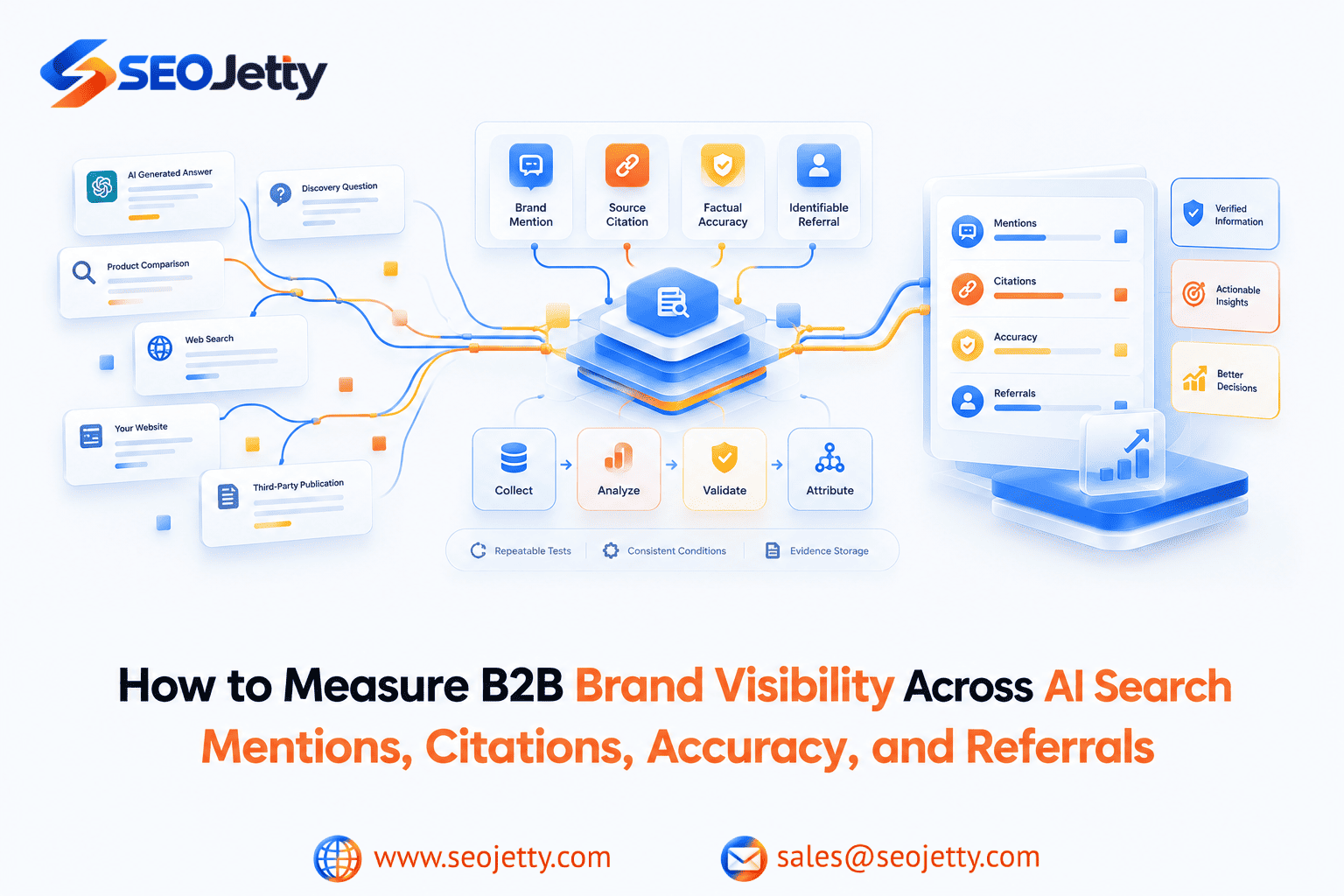
Use three reporting tracks with different interpretations. A search click, an observed brand mention, and a qualified sales opportunity answer different questions.
| Track | Measures | Interpretation limit |
|---|---|---|
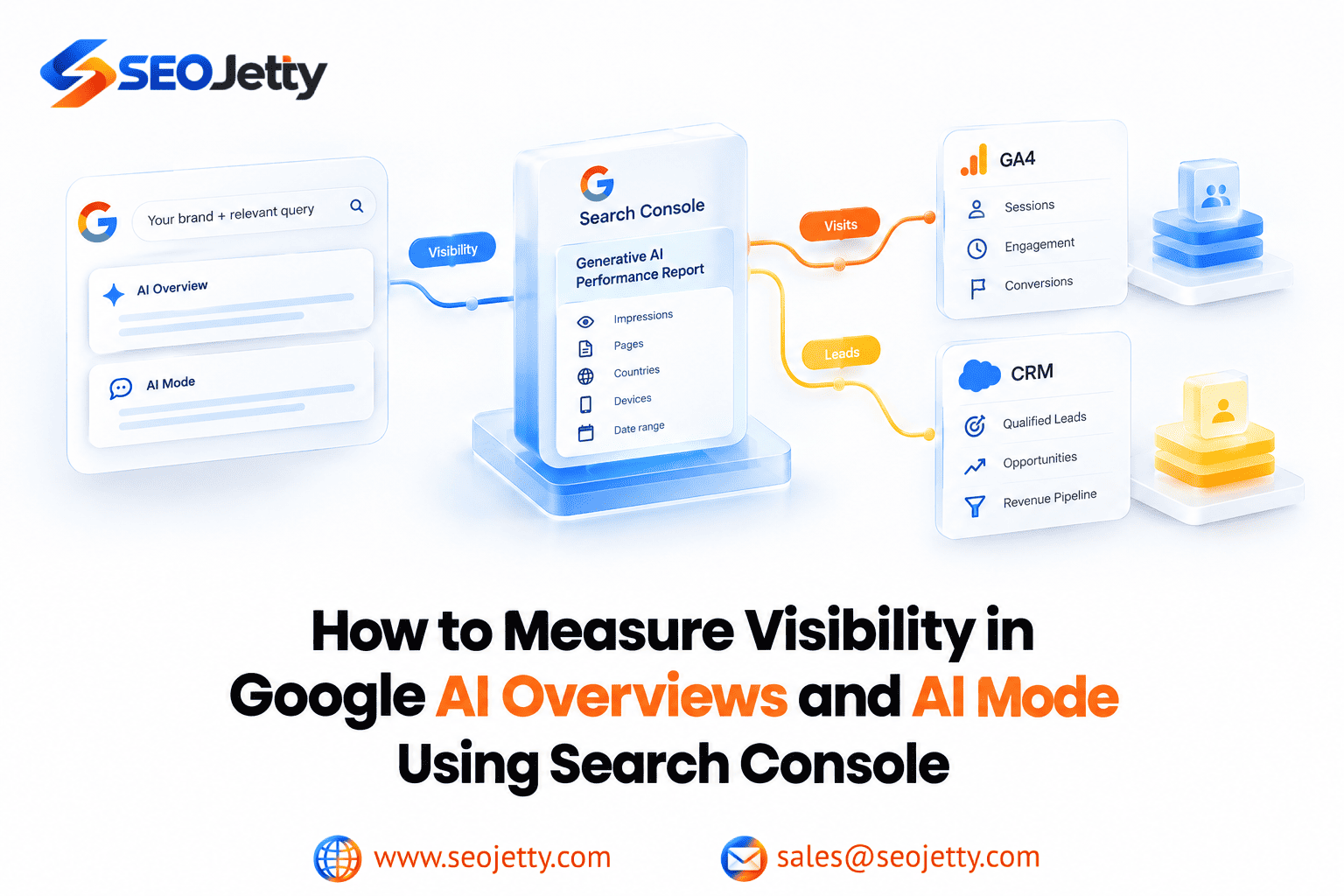
| Organic search | Country-filtered impressions and clicks, landing-page visits, priority-query performance | Search Console Web reporting includes Google’s AI-feature traffic; these totals are not a clean classic-search-only baseline. |
| Observed AI visibility | Mentions, cited URLs, factual accuracy, and competitor appearances in a defined prompt sample | A sample represents recorded tests, not total market exposure. |
| Commercial outcomes | Qualified demo requests, accepted opportunities, pipeline, and won revenue by market | Attribution may miss earlier interactions; referrals do not prove incremental revenue. |
For an initial AI-monitoring pilot, consider 20 buyer questions per market, repeated across selected platforms. Record the prompt, language, date, product mode, location setting where available, and whether web search was used. Keep branded and unbranded questions separate.
Report counts alongside rates. If your domain is cited in 6 of 20 comparable tests, that is a 30% observed citation rate for that sample. It is not a 30% share of all AI answers. Repeat tests to explore variability, and review whether the citations accurately represent your offering.
Track identifiable AI referrals in analytics as an additional signal, then connect qualified leads to CRM outcomes where possible. Ask prospects how they discovered the business without assuming that every AI-influenced visit carries a recognizable referral.
8. Use a 90-day implementation roadmap
Treat the first 90 days as a controlled delivery and learning period. The schedule below is a planning recommendation; it does not predict ranking gains or sales results.
| Period | Work | Owner | Completion evidence |
|---|---|---|---|
| Days 1–15 | Score markets, confirm product readiness, inventory overlapping pages, capture baselines | Growth lead with sales and product | Approved pilot markets, documented scores, retained-page plan |
| Days 16–30 | Map locale URLs, fix access issues, define measurement, approve localization briefs | SEO lead, developer, analyst | Validated templates, tracking specification, baseline report |
| Days 31–60 | Localize priority journeys, review product claims, test forms, begin relevant outreach | Product marketer and native-language reviewer | Approved pages and working conversion paths |
| Days 61–90 | Review indexing, repeat prompt tests, inspect lead quality, resolve gaps | SEO lead, analyst, sales | Market-level findings and expand, revise, or pause decision |
Budget for engineering, native-language review, product review, analytics, and maintenance as well as writing. Estimate these costs before approving more markets. A smaller complete journey is easier to evaluate than a large set of partially localized pages.
At day 90, expand only when the evidence supports it. If visits rise but leads are unsuitable, revisit targeting and messaging. If qualified interest exists but buyers cannot complete onboarding, resolve that operational gap before increasing acquisition spending.
Build the next market around evidence
A practical international AI SEO strategy connects market selection, local buyer needs, accessible pages, credible product information, and measurable commercial outcomes. Choose a manageable pilot, document assumptions, and use findings to decide what deserves further investment.
If you need implementation support, explore SEO Jetty’s International AI SEO service and discuss a scoped plan for localization, technical review, and market-level measurement.