
An international answer engine optimization framework is a working process for keeping software information accurate, accessible, and useful across markets and AI search experiences. For an enterprise software company, that means connecting product documentation, regional content, technical SEO, and measurement under clear ownership.
Start with a limited set of buyer questions and markets. Verify what buyers can actually purchase, deploy, integrate, and support in each location. Then improve the pages that answer those questions and test how different platforms represent the information. A citation is one observation; accurate information and a useful buyer journey are separate goals.
What international AEO includes—and what it cannot promise
Answer Engine Optimization (AEO) describes efforts to make information useful in answer-based discovery. Generative Engine Optimization (GEO) is another industry term, generally emphasizing generative responses. These labels overlap; neither is a single technical standard or a certification issued by answer platforms. Here, GEO means Generative Engine Optimization, not geographic targeting.
SEO remains part of the work. Google says existing SEO practices apply to AI Overviews and AI Mode, with no special optimization or AI schema required. Eligible pages must be indexed and able to appear with a snippet. Eligibility does not guarantee selection.
Keep Google Search AI features, the Gemini application, ChatGPT search, and Perplexity as separate test environments. A result in one does not establish how another will behave. Treat platform-specific access rules as documented facts and citation experiments as tests, rather than universal requirements.
1. Choose markets by buyer need and operational readiness
Begin with markets the business can serve and maintain. A country may need different commercial information without requiring another language; a language may serve buyers in several countries. Europe is not one locale, and translating a US page does not establish local product availability.
Ask regional sales, customer success, product, and support teams which questions delay evaluation. Useful starting points include deployment options, integrations, migration constraints, support coverage, pricing terms, and procurement evidence.
| Audience | Question to validate | Evidence needed | Accountable reviewer |
|---|---|---|---|
| US English buyers | Does the required integration support this edition? | Versioned integration documentation | Product owner |
| UK English buyers | Which contract and support terms apply? | Approved regional commercial terms | Commercial operations |
| German-language buyers | What hosting and support options are available? | Architecture facts and regional support scope | Product and regional lead |
| Australian English buyers | What happens outside local support hours? | Published coverage and escalation process | Support lead |
Build a page only when it serves a distinct need. If two markets have identical answers, a shared resource may be sufficient. Record why a separate version exists so future editors can distinguish useful localization from unnecessary duplication.
2. Establish an approved product facts register
Before rewriting content, agree on the underlying facts. A marketing page, developer guide, and partner listing should not describe three different capabilities for the same product edition.
Maintain a simple register with the product name, edition, feature, applicable markets, supporting source, owner, approval date, and next review trigger. Separate current availability from roadmap plans. Record limitations alongside benefits, including dependencies, configuration requirements, and unsupported deployment modes.
For example, a connector might support one product edition and require an additional license. A short statement that the software “integrates with” a platform can hide both conditions. Explain the scope on the integration page and link related regional pages to that maintained explanation.
This register is an internal governance recommendation, not a special file that AI systems must consume. Its purpose is to prevent conflicting public claims and make corrections manageable. Security, certification, and regulatory statements should go through the people authorized to approve them.
3. Localize decisions, terminology, and evidence
A useful regional page answers a local buyer’s question. Review how people name the software category, which procurement evidence they request, and which product details differ. Use native-language specialists with enough product knowledge to catch technically plausible but inaccurate translations.
- Use approved terminology for features, editions, and integrations.
- Explain regional availability, currency, contract scope, and support hours where relevant.
- Link to current technical or commercial evidence rather than repeating unmaintained summaries.
- Preserve warnings and limitations during translation.
- Let readers reach another language or market version through visible navigation.
Use AI to assist terminology comparisons or initial drafting, then review the result. Google’s generative AI guidance emphasizes accuracy, relevance, and added value; generating many pages without value can fall within scaled content abuse.
Do not invent local customers, regional certifications, or implementation experience to make a page appear relevant. Where evidence is unavailable, narrow the claim or leave it out. A precise explanation of a limitation is more useful to procurement than an unsupported assertion of universal suitability.
4. Validate international URLs and access
Google recommends separate URLs for language versions. An illustrative structure could use /en-us/, /en-gb/, and /de-de/. These directory names are organizational choices, not special ranking signals. Avoid making another language available only through cookies or location-based switching.
For corresponding localized pages, follow Google’s hreflang guidance. Include each page itself and its alternates, use reciprocal relationships and fully qualified URLs, and select valid language and optional region codes. Use en-GB, not en-UK. An optional x-default entry can identify a fallback or language selector.
Do not canonicalize every translated page to the English original. Check canonical choices alongside hreflang; for duplicate same-language regional content, assess the preferred canonical and regional annotations together. Hreflang is not a command forcing AI platforms to cite a particular page.
Site-owner discoverability checklist
- Check that each intended public URL loads successfully without authentication or server errors.
- Inspect robots.txt, robots meta directives, and HTTP headers for unintended restrictions.
- Confirm the preferred canonical and links between related public pages.
- Include preferred indexable URLs in sitemaps.
- Check that important rendered information is available to Google.
- Review Search Console URL Inspection and indexing reports.
- Check CDN and firewall behavior as well as robots rules.
These checks address access and discovery. Meeting Search Essentials, submitting a sitemap, or requesting indexing does not guarantee crawling, indexing, or ranking.
For ChatGPT search, OpenAI distinguishes OAI-SearchBot from GPTBot: search access and model-training preferences are independent. Review the search crawler and published IP guidance with the infrastructure team. Allowing training access is not a substitute for search access, and allowing search access does not ensure a citation. Review other providers’ current documentation separately.
5. Make important answers easy to verify
Organize pages around the decision a buyer needs to make. State the answer, explain its conditions, and provide supporting detail. An implementation guide might specify supported versions, prerequisites, configuration steps, failure conditions, and escalation routes.
For comparisons, publish the criteria and date of verification. For deployment claims, explain which component runs where. For migration guidance, distinguish supported automation from work that requires manual review. These details help readers evaluate the product without relying on broad marketing language.
Use headings, lists, and tables when they clarify the task. There is no prescribed answer length or heading formula that guarantees AI selection. Add structured data only when it accurately describes the visible page and serves a supported purpose. Validate it after template changes; do not label ordinary marketing content as evidence it does not contain.
Publish original technical findings when you can document their method and limitations. Keep partner profiles accurate, and pursue relevant editorial coverage because it reaches the right audience. Avoid purchasing links for ranking manipulation or creating artificial mentions to imply independent endorsement. Google’s spam policies cover link abuse and doorway content, as well as scaled content abuse.
6. Assign ownership and correction routes
International content needs both central consistency and regional review. Assign one accountable owner to each information type rather than letting every team edit every claim.
| Role | Primary responsibility |
|---|---|
| Product marketing | Approved product positioning and edition distinctions |
| Engineering or documentation | Technical accuracy, versions, and limitations |
| Regional editor | Language, terminology, and local buyer relevance |
| Legal or security reviewer | Approval of sensitive claims and supporting scope |
| SEO and web team | URLs, templates, access checks, and internal linking |
| Analytics owner | Test consistency and reporting limitations |
Trigger reviews when features launch, editions change, support coverage shifts, or evidence expires. If an AI answer misstates a feature, first check the public source material. Correct conflicting pages and track the observation; you cannot directly control whether or when a platform updates its answer.
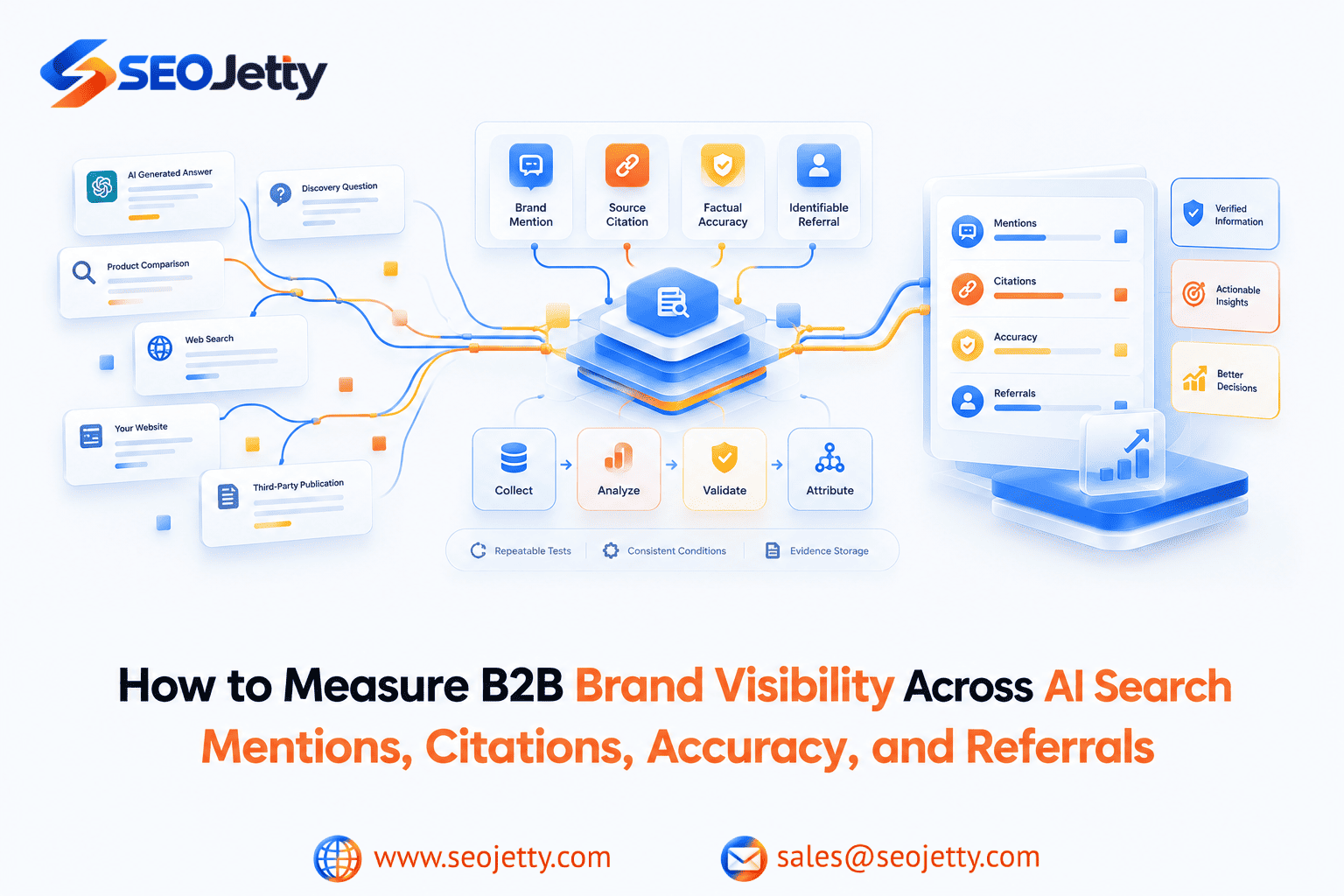
7. Measure mentions, citations, accuracy, and visits separately
Use a fixed panel of realistic buyer questions for each language and market. Include branded and unbranded questions, and keep them separate in reporting. Record the exact prompt, date, platform, available model or mode, search setting, language, location setting, answer, and linked sources.
Repeat observations under comparable conditions. Label translated prompts and locally researched prompts so teams understand what changed. Your panel is a diagnostic sample, not an estimate of every buyer’s experience or total market demand.
- Mention rate: Answers naming the brand divided by valid sampled answers.
- Citation rate: Answers linking to your domain divided by valid sampled answers. Record individual cited URLs too.
- Accuracy: Assess sampled factual claims against approved product evidence; log errors by severity.
- Referral activity: Report identifiable visits and conversions with the attribution method stated.
A brand mention may contain an error. A citation may point to the wrong locale. Neither establishes a qualified lead or incremental revenue. Investigate those outcomes independently, and use CRM evidence where consent and tracking arrangements permit.
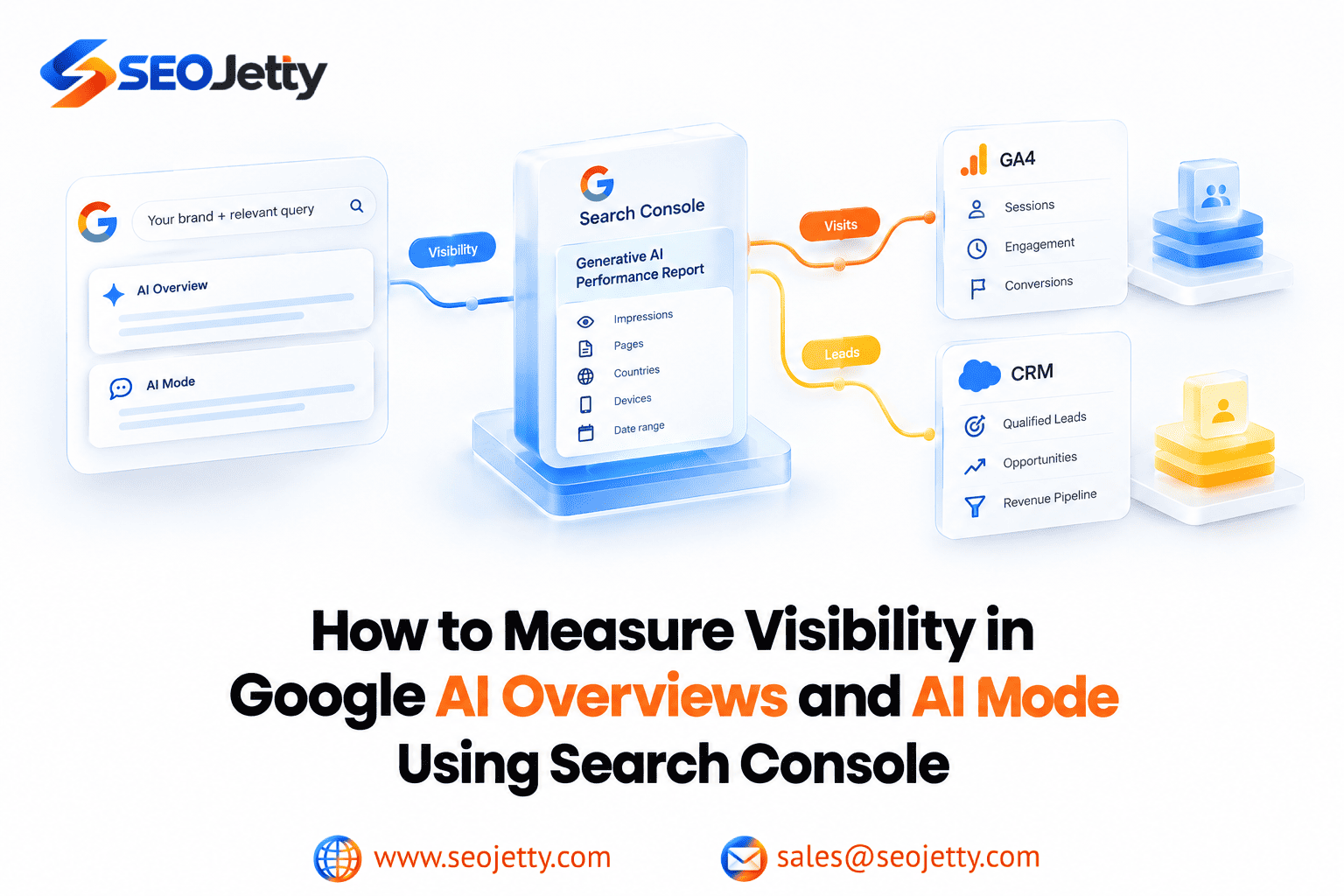
Google reports AI Overviews and AI Mode within the Search Console Performance report’s Web search type. Do not interpret overall Web traffic as a clean AI-only citation count. Likewise, missing referral information does not prove there were no AI-influenced visits.
A practical pilot before expanding
The following is a suggested work sequence, not a promised delivery schedule or results timeline.
- Baseline: Choose one software category and two maintainable locales. Inventory existing pages, approved facts, access issues, and a repeatable question panel.
- Repair: Correct contradictory capabilities, missing regional conditions, broken evidence links, and technical blockers. Record every material change.
- Improve: Revise priority evaluation and documentation pages with product and regional reviewers. Add useful detail rather than multiplying page count.
- Observe: Repeat the question panel, review errors and referral evidence, and account for product or platform changes before interpreting differences.
- Decide: Expand only when the team can maintain the evidence, ownership, and review process in another locale.
For teams assessing outside support, SEO Jetty lists International AI SEO, AEO, and content marketing services. Ask for a defined pilot scope, named reviewers, technical deliverables, and transparent measurement rather than a citation commitment.
A workable international framework gives every market a maintained source of product truth, accessible pages, accountable reviewers, and evidence the team can inspect. Use that foundation to identify where buyers receive incomplete or incorrect answers and choose the next improvement.