
A MarTech vendor can appear in an AI-generated comparison while being described with the wrong integration, deployment option or pricing model. A mention alone cannot tell the marketing team whether a buyer received useful information.
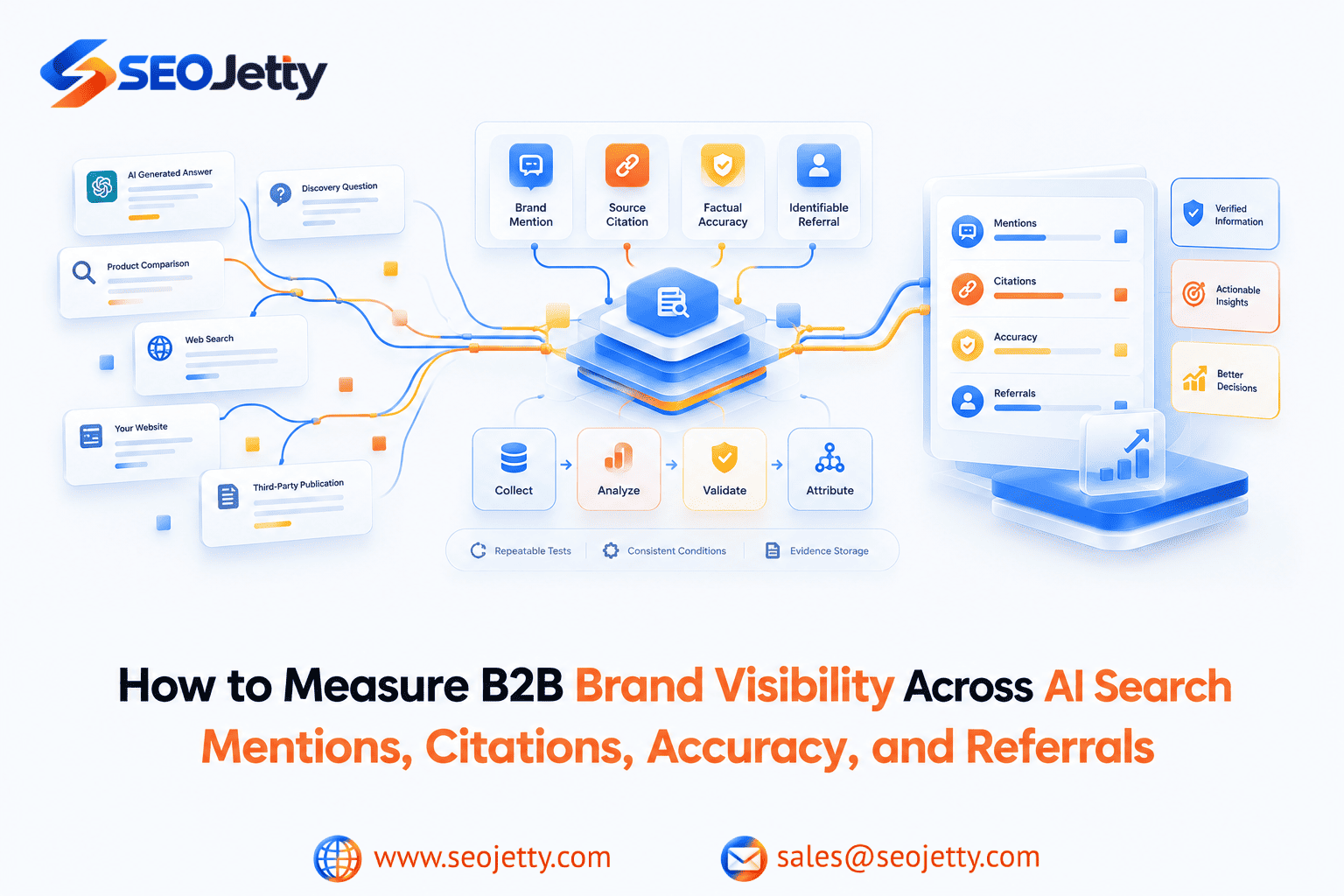
An AI search performance measurement framework should connect three questions: Are we appearing for relevant buying tasks? Is the information accurate and supported? What identifiable website and sales activity follows? Keep the evidence for each question separate so that a favourable answer does not become an unsupported revenue claim.
This guide proposes an internal measurement method. Its metrics and pilot sizes are recommendations, not platform-defined standards or universal benchmarks.
1. Start with a MarTech buying decision
Choose a product category and audience narrow enough to investigate. “Enterprise email automation for a team migrating from an existing platform” is more actionable than “marketing software.” Define the decision the report will support, such as which integration documentation to revise or which evaluation questions need clearer evidence.
Build a requirement matrix with product marketing, sales engineering and customer success. Typical MarTech requirements include CRM compatibility, event ingestion, consent handling, identity matching, data residency, implementation effort and reporting exports. Include only capabilities relevant to your product and buyers.
For each requirement, identify an approved source and a responsible owner. A claim about an integration should be checked against current documentation; a deployment claim may require confirmation from the product team. Do not treat a marketing slogan as proof of a technical capability.
2. Define what each metric counts
Create a metric contract before collecting answers. An observation is one recorded response to a specified question under recorded conditions. Count each brand or owned-domain citation at most once per answer for the rates below.
| Metric | Calculation or rule | Decision supported |
|---|---|---|
| Discovery mention rate | Completed unbranded answers naming the brand ÷ all completed unbranded answers × 100. | Which buyer tasks warrant further investigation? |
| Owned-site citation rate | Completed answers linking to an owned domain ÷ all completed answers in that segment × 100. | Which owned resources appear as sources? |
| Recommendation rate | Answers explicitly proposing the product as an option ÷ completed answers to the predefined recommendation-question set × 100. | Does the product enter relevant shortlists? |
| Verified product-claim accuracy | Correct assessed factual claims ÷ all assessed checkable claims × 100. List incorrect and unverifiable claims separately. | Which buying-critical descriptions need attention? |
| Collection coverage | Completed in-scope observations ÷ planned in-scope observations × 100. | Is this period comparable with the baseline? |
| Identifiable referral outcomes | Validated AI-source sessions, sessions with a demo-request key event, and separately reconciled qualified opportunities. | Are measured visits producing useful enquiries? |
Report the numerator and denominator alongside every percentage. Show accuracy as not applicable when there are no checkable claims. Ambiguous brand names require a matching rule based on product, domain and context; send uncertain matches for review.
A link to an external review is a third-party citation, even when it discusses your product. Record it separately from an owned-site citation. An answer may recommend a competitor while citing your educational article, so neither citation nor mention automatically means endorsement.
3. Assemble a balanced question set
Use actual sales objections, support themes and evaluation requirements as inputs, removing confidential information. Separate unbranded discovery questions from questions naming your company. Branded questions are useful for checking representation but cannot establish spontaneous discovery.
- Category discovery: “Which customer data platforms suit a midsize subscription business?”
- Integration evaluation: “What should a team verify before connecting marketing automation to its CRM?”
- Migration planning: “What evidence should buyers request before migrating event-based customer journeys?”
- Product verification: “Does support [specific capability], and what documentation confirms it?”
- Comparison: “How do and
-
Jetty Social AI
Price range: $119.00 through $159.00
differ for [defined requirement]?”-
Jetty Social AI
Price range: $119.00 through $159.00
-

Have regional reviewers adapt buying tasks for each market. A literal translation can miss local terminology or procurement expectations. Keep country, language and product segment visible rather than blending them into a global average.
Freeze a core question set for trend comparisons. Keep experimental questions in a separate collection until the team deliberately revises the baseline. Avoid filling the sample with questions that already include your brand.
4. Collect answers under documented conditions
A feasible pilot might use 24 questions across two selected experiences, with two scheduled runs per question: 96 planned observations for one market-language segment. This is a workload illustration, not evidence that 96 observations are statistically sufficient.
Choose platforms based on buyer relevance and collection feasibility. A ChatGPT search response, a Gemini app response and a Google AI Overview are different experiences. Record the product surface, visible model or mode, search availability, language, location settings where known, date and account conditions. API output should have its own series unless comparability has been demonstrated.
Use a consistent session procedure and collect on planned dates. Retain the question, full response, cited URLs and reviewer labels in an evidence log. Follow applicable platform access and collection terms when choosing manual or automated tools.
Log timeouts and access failures as missing observations. Retain valid answers that mention no vendors as zero-mention outcomes. When a Google result has no AI Overview, record feature absence separately from an answer that omits the brand. These distinctions prevent changing availability from masquerading as changing visibility.
5. Benchmark competitors without overstating share of voice
Compare each competitor’s mention rate on the same unbranded question set. Since one answer can name several vendors, those rates need not total 100%.
If management wants a share metric, define a bounded one: your brand-answer incidences divided by all brand-answer incidences for a fixed tracked vendor list. Count each tracked brand once per answer. Call it “share of tracked vendor mentions” and name the competitor set.
Hypothetical calculation: In 40 completed answers, your brand appears in 10, competitor A in 15 and competitor B in five. Your mention rate is 10 ÷ 40 = 25%. Your share of tracked vendor mentions is 10 ÷ 30 = 33.3%. The first denominator is answers; the second is brand-answer incidences. Neither measures total market share.
Repeated runs of the same question are related measurements. Small percentage changes should trigger evidence review before claims of meaningful improvement. Annotate changes in questions, competitors, settings and collection coverage.
6. Review the evidence behind product descriptions
Use a current product fact sheet to assess claims about features, integrations, commercial terms and deployment. Categorize discrepancies by practical consequence: a nonexistent CRM connector may matter more to a buyer than a shortened product description.
For every material disputed statement, inspect the cited page and record whether it supports the statement, is outdated or cannot be accessed. If no citation is supplied, record that limitation. ChatGPT’s search documentation explains that search responses may include source citations; a displayed link still requires editorial checking.
Assign corrections to the owner of the underlying information. Update inaccurate owned documentation, resolve contradictory product pages and request evidence-based corrections from external publishers where appropriate. Recheck both the source and later sampled answers. A source correction does not establish that every platform will immediately change its response.
7. Add native reporting and referral evidence
For Google, use the Search Console generative AI performance report to examine recorded impressions from AI Overviews and AI Mode. Current documentation provides page, country, device and date views, and states that worldwide rollout completed on August 31, 2026. A missing report can reflect insufficient impressions.
Keep these impressions separate from sampled mention rates and analytics sessions. Property-level and page-level aggregation differ. The documented report does not provide an individual-session link to a demo request. Do not create an “AI conversion rate” by dividing all Google organic conversions by AI impressions.
In GA4’s Traffic acquisition report, examine session source and session source/medium. Build an AI-source grouping from values you actually observe and validate. Test relevant landing-page redirects and campaign parameters before relying on classification.
For identifiable AI-source sessions, report sessions containing the agreed demo-request key event divided by those sessions. Reconcile CRM-qualified leads separately, deduplicating contacts and opportunities. State the attribution model and observation window. Buyer self-reports can add context but should remain separate from technical referral identification.
These records cover observable activity. They cannot count every buyer who reads an answer and later returns through another channel. A test prompt does not identify an actual visitor, and a referral does not prove that a particular content revision caused a sale.
8. Turn the monthly report into an action register
Use a short report with four views: collection health, buyer-task visibility, product accuracy and identifiable commercial outcomes. Every action should have supporting observations, an owner and a review date.
| Observed pattern | Next investigation | Owner |
|---|---|---|
| Outdated connector claims recur | Inspect integration documentation, release notes and cited third-party descriptions. | Product marketing and engineering |
| Mentions rise only on branded questions | Separate accuracy checking from unbranded discovery before changing investment. | SEO lead |
| Citations point to educational pages; enquiries remain scarce | Assess buyer intent, landing-page relevance and the next step offered. | Content and conversion teams |
| Scores shift as collection coverage falls | Repair collection and compare the consistently observed subset. | Measurement owner |
Prioritize a manageable correction or content improvement, record its publication date and compare subsequent periods under similar conditions. Treat changes as observations requiring explanation. Platform changes, competitor activity and seasonality can affect the same period.
Google’s AI feature guidance says established SEO practices remain relevant and no special AI schema is required. Useful documentation and accessible content serve buyers; formatting alone cannot guarantee citation.
Questions to settle before expanding the program
Should monitoring include paid placements?
Keep paid placements in a separately labelled dataset with their own cost and attribution rules. Mixing paid and organic observations can conceal what changed.
How should multiple products from one company be counted?
Maintain product-level labels and a parent-company mapping. Deduplicate the parent within an answer when reporting company visibility, while retaining product detail for portfolio decisions.
Can AI crawler logs measure buyer discovery?
Log analysis can document server requests after appropriate crawler verification. A crawl request alone does not demonstrate answer inclusion, a human impression or a buyer visit.
What if a cited URL redirects?
Store both the displayed URL and resolved destination. Map them consistently to the resource being assessed while preserving the original evidence.
When should a team purchase monitoring software?
Evaluate tools when collection or review exceeds capacity. Compare evidence exports, interface coverage, scheduling controls, failure handling and metric transparency against your written requirements.
How long should an answer archive be retained?
Set retention around audit needs, platform terms and internal information policies. Store only necessary evidence, restrict access and exclude confidential buyer details from public test prompts.
Build a framework that supports a decision
A useful MarTech measurement program identifies the buying task, documents how answers were collected and distinguishes visibility from accuracy and business outcomes. Start with one product segment, establish a baseline and assign evidence-based actions. Expand when the team can maintain consistent collection and review.
For help with the underlying search and content work, explore SEO Jetty’s GEO, AEO and SEO services and agree the measurement scope and deliverables before engagement.