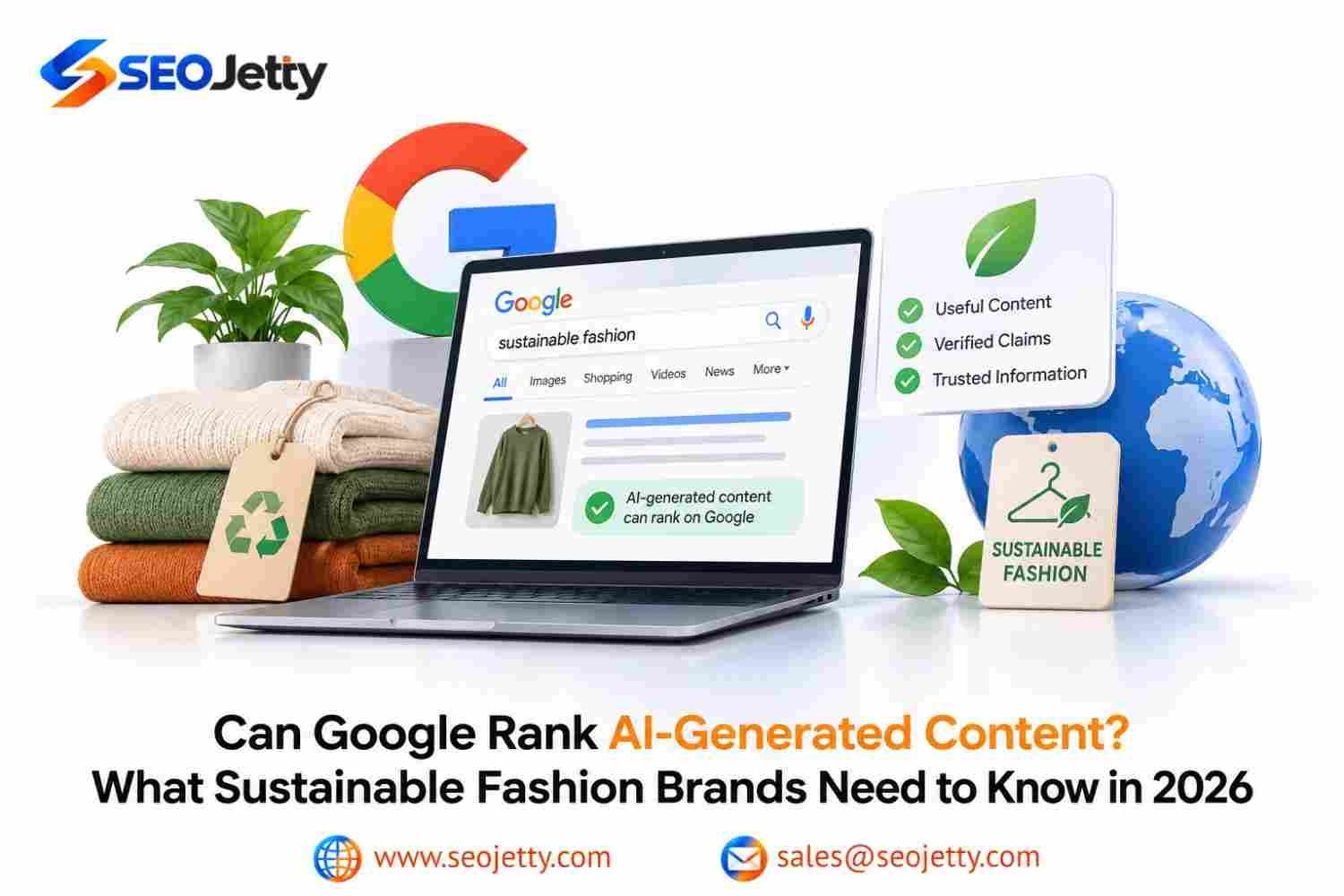
Yes. Google can rank AI-generated content. Using AI does not automatically disqualify a page from search results. Google’s guidance focuses on useful, reliable content and compliance with its spam policies, rather than treating the writing tool as the deciding factor.
For sustainable fashion brands, the harder question is whether that content deserves a shopper’s trust. An AI-written product description can sound convincing while inventing a certification, exaggerating a material’s benefits, or confusing a packaging claim with a garment claim.
A useful approach starts with verified product evidence, matches the reader’s task, and gives an accountable editor responsibility for publication. Here is how to apply that approach to fashion ecommerce.
What Google actually says about AI content
Google’s AI-content guidance explains that appropriate automation is compatible with its guidelines. Its newer generative AI documentation also recognizes uses such as research and structuring original material.
There is an important limit: generating many pages without adding user value can breach Google’s scaled content abuse policy. That policy concerns the purpose and usefulness of the publishing operation, regardless of how the pages are produced.
For example, creating hundreds of near-identical articles about “sustainable clothing in [city]” deserves scrutiny if each page offers the same generic advice. A detailed explanation of your own repair service, with accurate eligibility and costs, serves a more concrete need.
Human editing is a practical quality control, but it does not guarantee rankings. A polished article can still lack evidence, originality, or a useful reason to exist.
Why fashion content needs a stronger evidence check
Environmental claims influence how customers understand a product. Treat terms such as “eco-friendly,” “responsible,” and “sustainable” as claims requiring careful review, rather than decorative keywords.
The UK’s CMA fashion guidance addresses fabric descriptions, environmental ranges, and prominent qualifications. The FTC Green Guides summary cautions US marketers against broad, unqualified environmental benefit claims. Australia’s ACCC guidance emphasizes evidence and the overall impression a claim creates.
For EU audiences, rules introduced through Directive (EU) 2024/825 apply from 27 September 2026, according to the European Commission. Review the implementing requirements in the countries where you sell; a single global claim template may need local changes.
Search eligibility and advertising compliance are separate questions. A page appearing on Google is not evidence that its environmental claims are substantiated.
A practical workflow for AI-assisted fashion content
1. Match one page to one reader task
Decide what the visitor needs before asking AI to draft. An informational guide, a category page, and a product page should do different jobs.
- “How to wash a wool jumper”: provide clear care instructions, checked against the relevant garment labels.
- “Recycled polyester jackets”: help shoppers compare available products, composition, fit, and relevant limitations.
- “Where was this shirt made?”: provide verified product-specific sourcing information and explain any gaps.
Use customer questions, support tickets, and your own search data to refine the brief. These are starting examples, not verified keyword-volume opportunities.
2. Build a source pack before drafting
Give the writer or AI tool an approved set of facts. Include product specifications, composition records, current certificates where applicable, care instructions, and approved sourcing statements.
Keep a claim register with the proposed wording, supporting document, product or batch covered, limitations, reviewer, and review date. Separate product facts from brand ambitions. A future sourcing target should never become a claim about today’s entire collection.
Instruct the tool to flag missing information. If the records do not support a statement about water savings, fair wages, or biodegradability, leave the statement out pending verification.
3. Turn vague language into precise information
Consider this hypothetical draft: “Our planet-friendly jacket is made from 100% recycled materials and has no environmental impact.”
Suppose approved records establish only that the outer fabric contains 80% recycled polyester and 20% virgin polyester. A more precise description would identify that outer-fabric composition and describe the lining and trims separately using their verified specifications.
That narrower statement still needs evidence. It does not establish that the whole garment is recycled, that it is recyclable locally, or that it has a lower overall footprint than another jacket.
Keep important qualifications beside the claim. A linked sustainability report can supply detail, but should not be used to hide a limitation necessary to understand the headline wording.
4. Add information your business can actually contribute
Useful originality often comes from the product team, repair team, or customer service desk. Ask what they know that a generic article cannot provide.
Examples include documented repair instructions, original construction photographs, explanations of a design trade-off, and answers to recurring questions about fit or care. Describe the scope and method of any testing you report. Do not turn an informal observation into a laboratory result.
A materials specialist can review technical explanations. A sourcing colleague can check supplier statements. Credit people accurately; never invent credentials or imply an independent review that did not happen.
5. Edit for buying decisions and comprehension
Organize the page around the questions readers need answered. Product content should make composition, fit, care, availability, and relevant sourcing information easy to find. A materials guide should explain definitions, practical uses, and limitations.
Use headings, short paragraphs, and comparison tables where they help. Include related vocabulary naturally, such as fiber composition, traceability, garment repair, and recycled content. There is no useful reason to force “sustainable fashion” into every heading.
Read the final copy alongside the product record. Check percentages, units, material names, certificate scope, and claims in image captions as carefully as the main text.
6. Approve a small batch before expanding
Start with a manageable group of pages. Assign an editor to check audience usefulness and a relevant product or sourcing reviewer to approve technical claims.
Record recurring errors and fix the source pack or drafting instructions before generating more. If AI repeatedly invents certification language, expanding production will multiply the review burden.
For existing pages, update the useful URL where possible. Creating another version for a slightly different query can split attention and leave shoppers unsure which information is current.
Apply the workflow to different ecommerce pages
Product descriptions: ground the copy in each item’s actual specifications. Similar garments may share a structure, but the distinctions should help shoppers choose. Extra adjectives do not create useful differentiation.
Category pages: explain what qualifies a product for the collection. If a category uses a recycled-content threshold, define it accurately and make sure every listed product meets it. Avoid a broad environmental label that the selection criteria cannot support.
Materials and sourcing guides: distinguish general information about a fiber from evidence about your supply chain. A discussion of organic cotton does not prove that a particular garment is certified or that its production achieved a specific water reduction.
Care and repair resources: provide practical steps, clear photographs where available, and product limitations. These pages can answer real ownership questions even when the reader is not ready to buy another item.
What about AEO, GEO, and Google’s AI features?
Answer Engine Optimization and Generative Engine Optimization describe approaches to visibility in answer-driven search. They do not replace evidence or basic SEO.
Google’s AI features documentation says no additional special optimization is required for AI Overviews or AI Mode. Clear explanations and helpful structure serve readers, but cannot ensure selection or citation.
Do not assume Google’s guidance establishes the selection rules for every other answer platform. Evaluate each platform separately and avoid promises that a particular paragraph format will produce AI mentions.
Measure usefulness and search performance together
Record the revision date and a baseline for the pages you change. Review relevant search queries, impressions, clicks, click-through rate, and average position, alongside product-page visits and purchases where measurement is available.
For an internal pilot, compare revised pages with reasonably similar unchanged pages over comparable periods. Account for promotions, stock availability, seasonality, and site changes. A before-and-after increase alone does not prove that human editing caused better rankings.
Track editorial outcomes too: unsupported claims caught, corrections required, and recurring customer confusion. If a page attracts visitors but leaves them unable to understand the product, revise the explanation rather than simply adding keywords.
Frequently asked questions
Should we put an AI disclosure on every page?
Consider disclosure where readers would reasonably want to understand how the material was created. Explain meaningful review steps truthfully. A disclosure cannot substitute for accurate product information; check any applicable market requirements separately.
Can we reuse a supplier’s description?
Check permission and accuracy first. Then add relevant information your customers need, such as product-specific fit or care guidance. Rewording the supplier’s text alone adds little practical value.
What if certification evidence has expired?
Pause the affected claim for review. Confirm the relevant product, batch, certificate scope, and dates with the responsible team before deciding what wording remains supportable.
Can AI translate our sustainability pages?
It can assist with a draft. Have a qualified language reviewer check material names, qualifications, and meaning, and obtain appropriate local review of regulated claims. Preserve important limitations in the translated page.
Should we delete every older AI-written article?
Review each page’s accuracy, purpose, overlap, and usefulness. Update worthwhile resources, consolidate overlapping material where appropriate, and remove content that has no continuing value. The creation method alone is insufficient grounds for deletion.
What should trigger an immediate content review?
A changed supplier, altered composition, new certification status, revised care instructions, or a credible customer complaint should prompt review of affected copy. Keep a list of the pages using each claim so corrections reach every relevant location.
Build a process customers can trust
AI can help draft fashion content, but the brand remains responsible for what it publishes. Start with evidence, answer a specific customer question, and keep claims accurate as products change.
If your team needs help planning this work, explore SEO Jetty’s content marketing service and discuss your editorial priorities and review responsibilities.