The way people search for information is changing — fast. Millions of users are now turning to ChatGPT, Google’s AI Overviews, and other AI-powered tools to get answers instead of clicking through pages of search results. For businesses, this shift raises one critical question:
Is your business showing up when AI answers questions about your industry?
If not, you’re leaving a massive opportunity on the table. At SEO Jetty, we help businesses adapt their SEO strategy to stay visible — not just on Google, but inside AI-generated answers too. In this guide, we’ll break down exactly what SEO for ChatGPT visibility means, why it matters, and what you can do about it today.
What Is ChatGPT Visibility — and Why Should You Care?
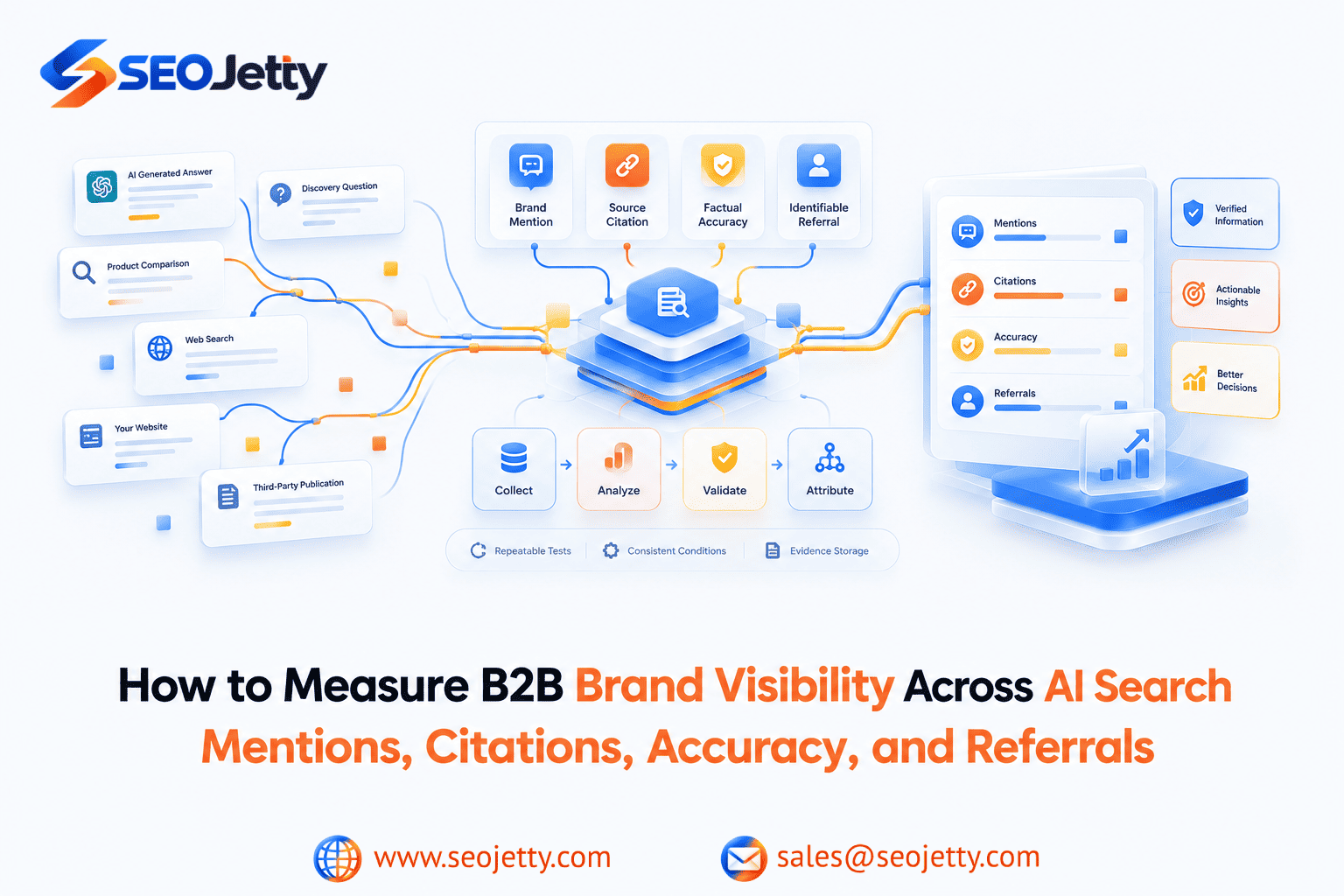
ChatGPT and similar AI tools (like Google’s AI Overviews, Bing Copilot, and Perplexity) pull information from the web to generate responses. When someone asks “What’s the best SEO agency near me?” or “How do I improve my website rankings?”, the AI doesn’t just make things up — it pulls from credible, well-structured online sources.
The businesses and content pieces that get cited are the ones that are:
- Authoritative and trustworthy in their niche
- Structured in a way that’s easy for AI to read and understand
- Consistently creating content that answers real questions
This is the new frontier of SEO — and it’s called AI Search Optimization or Generative Engine Optimization (GEO).
How ChatGPT Decides What to Show (And What to Skip)
To optimize for ChatGPT visibility, you first need to understand how it works.
ChatGPT is trained on vast amounts of web content. When generating a response, it prioritizes sources that are:
1. High in E-E-A-T (Experience, Expertise, Authoritativeness, Trustworthiness)
Google’s quality guidelines and AI systems both reward content created by people who demonstrably know their subject. If your website content lacks author bios, credentials, or original perspectives, AI tools may overlook it entirely.
2. Structured and Scannable
AI models are fantastic at parsing well-organized content — headers, bullet points, FAQs, numbered lists. Dense, unformatted text is harder to process and less likely to be surfaced.
3. Cited and Linked Across the Web
When other reputable websites reference your content, AI tools take that as a strong signal of credibility. Think of it as digital word-of-mouth at scale.
4. Comprehensive and Specific
Vague content gets ignored. Content that thoroughly answers a specific question — with context, nuance, and actionable detail — is far more likely to be picked up by AI.
7 Proven SEO Strategies to Boost Your ChatGPT Visibility
1. Optimize for Conversational, Question-Based Keywords
People ask ChatGPT questions in natural language — “How do I rank higher on Google?” not just “rank higher Google.” Your content needs to reflect this shift.
What to do:
- Use tools like AnswerThePublic, AlsoAsked, or Google’s “People Also Ask” to find question-based queries in your niche.
- Create content that directly and clearly answers these questions.
- Structure your headings as questions where it makes sense (e.g., What is the best way to do keyword research?)
At SEO Jetty, we audit your existing content to find gaps where question-based optimization can dramatically improve your AI visibility.
2. Build Topical Authority with Content Clusters
ChatGPT trusts websites that cover a topic deeply — not just broadly. A site with 50 interconnected articles on SEO is seen as far more authoritative than a site with one generic post.
What to do:
- Choose 3–5 core topics central to your business.
- Build a content cluster: one detailed pillar page per topic, supported by multiple specific sub-articles that link back to it.
- Cover every angle of the topic — beginner guides, advanced tactics, FAQs, case studies, and comparisons.
This signals to both traditional search engines and AI tools that your website is a go-to resource.
3. Add Structured Data (Schema Markup) to Your Website
Schema markup is code added to your website that helps search engines and AI tools understand what your content is about. It labels your content so machines can read it clearly.
The most valuable schema types for AI visibility:
- FAQ Schema — Makes your Q&A content easily parseable
- HowTo Schema — Perfect for step-by-step guides
- Organization Schema — Helps AI understand who you are and what you do
- Article Schema — Establishes authorship and publication date
If your website doesn’t have schema markup, you’re essentially speaking a language AI tools struggle to understand. SEO Jetty’s technical SEO services include full schema implementation for your site.
4. Strengthen Your Brand’s Online Presence (Digital PR)
AI tools like ChatGPT are more likely to mention your brand if it appears frequently across reputable, third-party sources — news sites, industry publications, review platforms, and directories.
What to do:
- Get featured in relevant online publications and blogs (guest posting, expert quotes, interviews).
- Ensure your business is listed accurately on Google Business Profile, industry directories, and review sites.
- Build backlinks from trustworthy, niche-relevant websites.
- Encourage satisfied customers to leave reviews on Google and other platforms.
The more your brand appears as a cited entity across the web, the more likely AI will reference you when users ask related questions.
5. Create Content That Directly Answers AI Prompts
Think about the exact questions your target customers might type into ChatGPT. Now create dedicated content pieces that answer those questions better than anyone else.
Examples of high-value AI-targeted content:
- “What is the best SEO strategy for small businesses in 2025?”
- “How long does SEO take to show results?”
- “What should I look for when hiring an SEO agency?”
These aren’t just blog posts — they’re answers. The more directly and thoroughly you answer, the higher the chance an AI tool will pull from your content.
6. Focus on Long-Form, In-Depth Content
Short 300-word blog posts won’t cut it anymore. AI tools prefer comprehensive resources that cover a topic from multiple angles.
Best practices for long-form content:
- Aim for 1,500–3,000+ words for core topic articles
- Include real examples, data points, and case studies
- Use clear headings and subheadings (H2, H3)
- Add a FAQ section at the end of every major article
- Keep content updated — AI prioritizes fresh, accurate information
Quality always beats quantity, but thoroughness signals authority.
7. Optimize Your Google Business Profile and Local Listings
If you serve a local market, your Google Business Profile is one of the most powerful assets for appearing in AI-generated local search answers. ChatGPT and AI Overviews frequently pull local business information directly from Google’s local index.
What to do:
- Claim and fully complete your Google Business Profile
- Keep your NAP (Name, Address, Phone Number) consistent across all listings
- Add services, photos, FAQs, and regular posts to your profile
- Actively collect and respond to Google reviews
Even if you operate nationally or globally, local authority signals still strengthen your overall brand credibility.
Common Mistakes That Hurt Your ChatGPT Visibility
Knowing what not to do is just as important. Here are the most common pitfalls we see at SEO Jetty:
- Thin, generic content — Pages that say very little, very vaguely. AI skips these.
- No author information — Anonymous content lacks the E-E-A-T signals AI looks for.
- Ignoring technical SEO — Slow-loading pages, broken links, and poor mobile experience signal low quality to all search systems.
- Inconsistent brand information — If your business name, address, and services differ across platforms, AI tools get confused and may not trust your data.
- Keyword stuffing — Outdated tactic. AI understands context, not just keyword density. Write for humans first.
The Future of SEO Is AI-Optimized
Traditional SEO — ranking on page one of Google — is still important. But it’s no longer the whole picture. As more people turn to AI for answers, the businesses that win will be those that show up inside those AI responses.
This doesn’t mean abandoning what works. It means building on it — creating deeper content, stronger authority signals, and a more structured online presence that both human searchers and AI tools can trust.
At SEO Jetty, we specialize in future-ready SEO strategies that cover all the bases: technical SEO, content strategy, link building, local SEO, and now — AI visibility optimization. Whether you’re a startup trying to build a digital footprint or an established brand looking to stay ahead of the curve, we have the expertise to get you there.
Ready to Get Found on ChatGPT and Beyond?
The shift to AI search is happening right now. Every month you wait is a month your competitors could be getting mentioned in AI answers instead of you.
SEO Jetty is here to help you adapt, compete, and win.
📞 Contact us today for a free SEO audit and discover exactly what it will take to boost your visibility — on Google, on ChatGPT, and everywhere your customers are searching.
SEO Jetty — Navigating the Future of Search, One Ranking at a Time.